


Want designers to embrace AI? Stop focusing on the tools

The fastest way to stall an AI transformation may be to give everyone more AI tools.
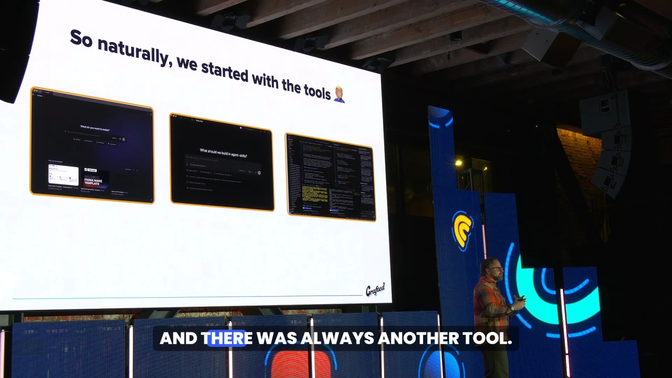
That is one of the harder lessons Travis Isaacs, Vice President of Design at Cisco, learned while trying to transform his organization into an AI-native team. Codex. Figma Make. Cursor. Each new tool seemed capable of removing another obstacle between designers and the future.
Except the transformation didn’t follow.
“The bottleneck that I found was mindset and not tools,” Travis said. His team needed something more fundamental than another license or tutorial. They were wrestling with what happens to their value when the work they spent careers mastering can suddenly be generated in seconds.
That question should sound familiar to design leaders. AI adoption is often framed as a technology problem: Which tools should we buy? How should we train people? Which workflows can we automate?
But underneath those questions is a much more consequential one: What does it mean to be a designer when making things is no longer the scarce skill?
VIDEO
Building an AI-Native Team
Watch Travis's keynote presentation on Insights+
AI transformation requires a new definition of craft
Design has long intertwined craft with execution. The ability to turn an idea into a beautiful interface mattered partly because doing so required expertise, time and specialized tools.
Generative AI is rapidly lowering those barriers.
Travis describes the resulting shift as moving from maker to supervisor. Instead of manipulating every element ourselves, designers increasingly direct systems, evaluate their output and decide what deserves to survive the next iteration. Craft moves upstream.
“Taste and judgment are applied through discernment rather than manipulation,” he said.
That doesn’t make craft less important. It may make it more important.
UserTesting’s recent research on defensible design in the age of AI found that 91% of designers say AI makes them faster, yet only 15% feel much more confident in what they ship. Nearly half say AI-generated work can sound right while remaining difficult to verify.
AI has made output abundant. Judgment remains scarce.
That distinction changes what designers should cultivate. Travis points to empathy, context, creativity, taste and storytelling as uniquely valuable contributions humans bring to the loop. Designers still have to understand the customer, recognize an unexpected connection, decide what “good” looks like and persuade an organization to act on it.
The mouse may move less. The judgment behind it matters more.
AI adoption is not the same as AI activity
There is another seductive trap in AI transformation: mistaking experimentation for progress.
Give a design team access to generative AI and activity arrives almost immediately. People prompt. Prototype. Generate variations. Build things that would have taken weeks in an afternoon.
It feels productive because there is always something new on the screen.
Travis discovered the limits of that approach after initially encouraging broad experimentation across his organization. His hope was that enough experiments would eventually reveal the path forward.
“It didn’t,” he said.
Instead, AI made it easier to move quickly without necessarily moving correctly. As Travis put it, “the only limit to going the wrong direction is how much you’re willing to spend on tokens.”
That idea echoes a broader challenge facing design teams. In a recent Insights Unlocked conversation about designing with AI, Louis Rosenfeld and Llewyn Paine argued that speed itself is becoming a dangerous proxy for progress. As generating outputs gets easier, defining quality, intent and meaning becomes harder.
The answer isn’t less experimentation. It’s experimentation with a destination.
Travis eventually moved his organization from open-ended exploration toward targeted outcomes, defined adoption signals and decisions that could demonstrate actual progress.
An AI mindset starts with customer context
There is a design principle hiding inside this management lesson.
When generating becomes cheap, learning becomes disproportionately valuable.
A designer can ask an AI tool to produce 50 versions of a checkout flow before lunch. But version 51 is unlikely to solve the problem if nobody understands why customers abandoned the first 50.
That is why human insight becomes more—not less—important as AI accelerates design. UserTesting’s MCP server, for example, brings real customer context into tools such as ChatGPT, Claude and Figma Make so designers can generate from evidence rather than assumption and validate concepts as they work.
The meaningful shift isn't simply from slow design to fast design. It is from producing artifacts to reducing uncertainty.
That requires a different mindset about what counts as progress.
Design leaders have to change the signals
Perhaps the most revealing moment in Travis’s AI transformation came during a design review.
One team arrived with a beautifully polished prototype created after months of work. Another arrived with something rougher built quickly in Cursor—but that team had already put its idea in front of people, gathered feedback and reduced uncertainty around the solution.
The second team represented the behavior Travis wanted.
But leaders cannot tell teams to experiment, learn and validate quickly while continuing to lavish praise on polish. Organizations notice what leaders celebrate.
So Travis began changing the signals: from beautiful to useful, polish to testing, speed to learning, and certainty to de-risking choices.
That may be the real work of AI transformation.
Not installing another tool. Not announcing another pilot. Not waiting for a handful of AI enthusiasts to show everyone else the future.
It is redefining what good work looks like—and giving designers permission, expectations and evidence to work differently.
As Travis put it: “The values your team executes against are the ones you reward, not the ones you announced.”