

Early access
Go beyond the first answer
Bring more conversational depth to unmoderated research. AI Moderation responds to what participants say and asks relevant follow-up questions in the moment, helping teams uncover more of the why behind a response.

Limited early access available.
Get more depth from unmoderated research
AI Moderation makes unmoderated research more responsive, helping teams explore what participants mean, expect, and react to with relevant follow-up questions as the session unfolds.
Follow up when something matters
Go beyond interesting, incomplete, or unexpected responses with relevant questions based on what each participant actually says.

Understand more of the why
Explore the reasoning, expectations, hesitation, and context behind participant responses so teams have more than the first answer to work with.

Bring conversational depth across more sessions
Add richer qualitative questioning across unmoderated studies, with follow-up questions that respond to what each participant actually says.

Guide the conversation
Give AI Moderation context about what you want to learn so it can focus its follow-up questions on the topics that matter most.
The complete exchange stays connected to the session recording and transcript, giving teams richer context to review and analyze.
Part of a broader AI-powered research workflow
AI Moderation helps deepen the customer conversation. Expanded UserTesting MCP capabilities can bring complete session conversations back into AI-enabled workflows for analysis and synthesis.
See AI Moderation in action
See how AI Moderation responds to what participants say and asks relevant follow-up questions within an unmoderated Think Out Loud study.
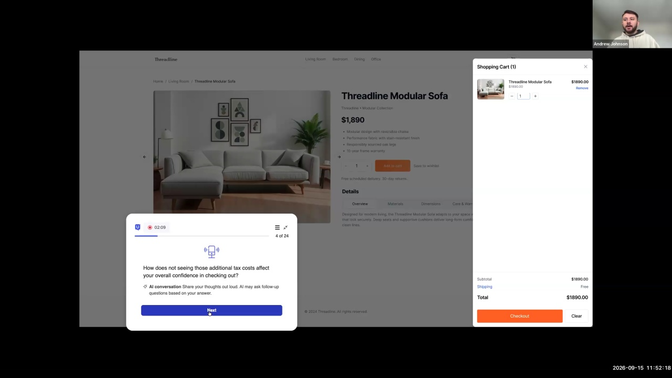
Limited early access is available for select customers.
Bring more conversational depth to your next study
See how AI Moderation can help your team get more from unmoderated research.
Request Early Access
FAQ
Top Recruiting Features
How teams use MCP

With UserTesting connected via MCP, teams can bring behavioral data and UserTesting qualitative insight into the same Claude or ChatGPT session. Ask why checkout abandonment is rising and get an answer that draws on web analytics funnel data and UserTesting verbatims together — so the brief that comes out of it is sharper, more defensible, and visible to the people making decisions in real time.

When you prompt Figma Make or Claude without customer context, the model only knows patterns — not how your specific users actually think or abandon. MCP loads real customer insight before it generates anything, so the first direction is more accurate. And when you've already built something fast and need to validate it, UserTesting is right there — no separate tool, no broken flow.

Study creation and recruiting through User Interviews happen alongside each other — inside Claude, ChatGPT, or Figma Make. Insights surface in Slack and AI assistants where the rest of the team already is, so decisions get made with real customer understanding — not because insights got louder, but because it got closer to where decisions happen.