
Ken Hughes | Connection is Everything: The Power of Customer Experience
Ken Hughes
Leading Consumer Behaviouralist, & The King of Customer Experience
Customer Experience (CX) has significantly evolved beyond its original call centre and customer service roots. CX is no longer just about transactional or service-oriented resolution, but a core philosophy and a key pillar of strategic success.
UX and CX are all about connection. It is about building a tribal sense of belonging for customers and ensuring they feel seen, heard and valued. It is about leaning into customer intimacy and authenticity. It is about building community, co-creating and collaborating with our customers.
Today, those who work in the UX and CX space have more influence over brand image and perception than those in sales or commercial roles. A customer's experience is everything.
Understanding how to optimise these experiences is the new branding battlefield.
In a deeper, digitally driven society, every customer touchpoint is affected by the seismic shifts in customer expectations. We all find ourselves in a race for relevance – a race in which the need to understand the values and insight of the 'shopper of tomorrow' is key.
This keynote explores the nature of the modern consumer connection and challenges every brand to better understand the values of the modern consumer.
Speaker 1
We've got Ken Hughes, the king of customer experience.
Good evening to you all.
All good?
Speaker 2
You're better than me. Let me explain.
Speaker 1
I have to explain this about fashionable couturement first.
So let
Speaker 2
me tell you a story.
I've I've been a climber all my life. I love the adrenaline of a climb. Not so much the adrenaline of a fall, but of a climb. So let me tell you a story about the Abrizzi Spur.
The Abrizzi Spur is actually, on on the left here, it looks quite flat, isn't...
Speaker 1
We've got Ken Hughes, the king of customer experience.
Good evening to you all.
All good?
Speaker 2
You're better than me. Let me explain.
Speaker 1
I have to explain this about fashionable couturement first.
So let
Speaker 2
me tell you a story.
I've I've been a climber all my life. I love the adrenaline of a climb. Not so much the adrenaline of a fall, but of a climb. So let me tell you a story about the Abrizzi Spur.
The Abrizzi Spur is actually, on on the left here, it looks quite flat, isn't it? It's the most common approach to the peak of K2. But on the right you can see it's not not a forgiving space and if you take a fall on that, you're pay the price. So I took a 15 foot fall collided with the rock face and severed the arm beautifully from the shoulder.
It melted clean like a hot, nice little butter. And so the story then of a fourteen hour descent with an arm truding out of your body and finally the medevac out of there.
Quite a dramatic story, isn't it? And then obviously, this is only three weeks ago. So that's me post op. So now I've got a big titanium piece reattaching the shoulder. I call it I call it Usain.
This is
Speaker 1
a fair amount of bolts in there
Speaker 2
holding it all together.
And so that's only three weeks ago. So delighted to be invited here. Thank you so much. But this keynote is co sponsored by user testing and OxyContin.
So if it goes off in a weird tangent, that's why. Just a good thing to know. So I'd like to tell you that story. I really would. But that's not what happened at all.
Speaker 1
This is my cat, Skittles.
Speaker 2
I tripped over my cat four weeks ago.
That's it. I was in my own home, tripped over my cat. The story is the same. The same injury, the same horrific metal plates, all the surgery. It's just not as dramatic as a big wonderful medivac in K2. Apologize. So anyone whose cats watch it, they're vicious vicious faucets.
Alright. Let's go on then. So 2026, here we are. We're one year into the beta generation.
It's the seventh generation of consumers and users that have joined us. It's really interesting. We've never had seven before. Now We've never had seven generations of users to research, to design product for.
So now we design for everyone from the traditionalist who were born after World War two, born into the Great Depression, a very manual generation. Everything was done by hand. And then that gave way, of course, to the boomer generation. The boomer generation came of age during the Vietnam War, Richard Nixon era.
And they were a, I guess, generation. Everything was kind of analog. It was typewriters. It was worldly telephones.
It was a vinyl. And then that gave way first to to Gen X. Gen X, again, MTV culture.
And then we were the first low tech generation Gen
Speaker 1
X.
It was the Sony Walkman. It was the Discman.
Speaker 2
It was the game consoles. Then that gave away from millennial generation. Millennial generation were the Internet generation. They came of age. They entered the workplace post 09/11. They were the first digital generation. It was iPod, iPad, iPod.
And again, as geopolitical unrest came our way, they were a streaming generation. So it's kind of everything is accessed on old, low level AI, Siri, Alexa, and now we have Gen Beta. Gen Beta will be, of course, an AI fueled generation, a humanoid robotic fueled generation, a quantum computing fuel generation, a generation of users that we, you know, we don't really understand yet yet yet on firm. And so if you look at those seven generations, it's really interesting next year, 2027, is the midpoint. 2027 is the midpoint where half the millennials will be over 14 and half the millennials will be 40. In fact, if you look at the the data at the moment already in The UK, we're already at kind of over that tipping point where 53% of all users that we design product for are millennials and under.
And that means that it's it's it's important to understand because the the older generations, traditions, bloomers, the geneticists, they have a certain way of doing things,
Speaker 1
a certain way of
Speaker 2
looking at business channels, a certain way of looking at user of any product.
And then the younger generations have a different way of looking at things. And we don't if we don't design for the future consumer, we lose our relevance to them. And so let me give you an example. This is a Gen Z kid being shown a cassette tape for the first time. Have a look at this. Demonstration on how to listen to a tape.
You're just getting rattles.
Speaker 3
Have you turned it on?
Speaker 4
Something that needs batteries.
Speaker 3
You plug it inside this so basically somehow plugs it into like like the TV and it's watching for you.
Speaker 2
It's my favorite part. He wants to be virtual reality. And so I had this this event too with my son recently. My son is 20 in university.
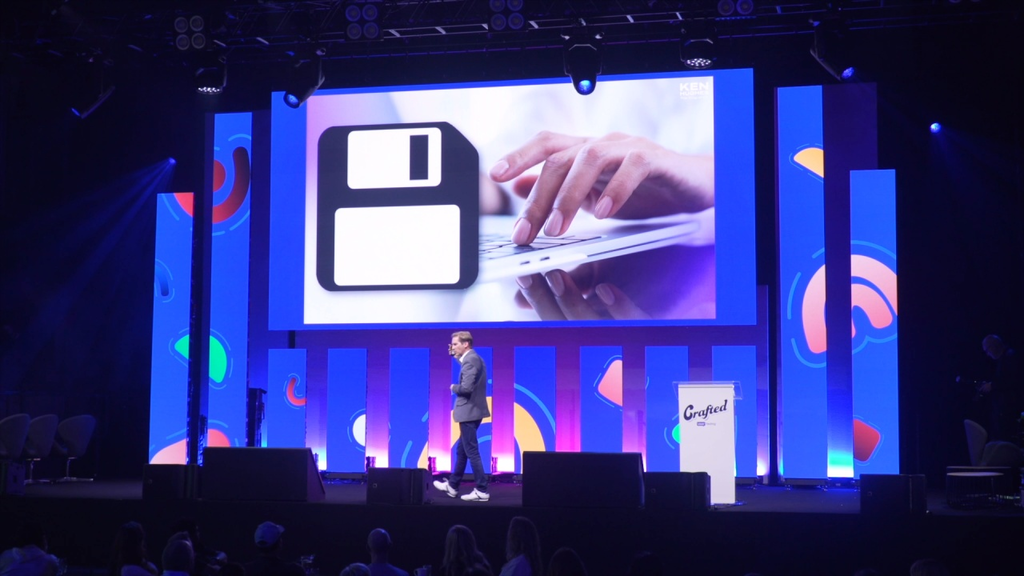
He was writing an essay for sociology. And he asked me a question. He's never asked me before and to be fair, he'll never ask me again. He said, dad, why is the save icon a microwave over a television?
Speaker 3
I said, what? I said, why is it a microwave over a TV?
I thought, oh
Speaker 1
my god.
Speaker 2
My son is stupid.
And then I thought, well, to be fair, if you think about this digitally from a user experience, He's never seen one of those and he's not saving to one of those, which is the main point. So why aren't we as software engineers showing him a cloud in the model as that icon? Because that's what he's doing. Saving to the cloud.
Why are we stuck in our ways, our interpretation of the way the world works? And that's the the scary thing about user design is that also we look at things from our perspective. And while they're they're kind of funny jokes and this is flopidistic cassettes, but it's not so funny when the next generation look at your product and service and think, what the hell is that? That doesn't meet my needs.
It doesn't meet my design needs. And so that's the the race for relevance that we find ourselves in. This is Lauren McCall, a famous Hollywood actress. She was married to Humphrey Bogart.
She had a wonderful quote that I've always loved. Standing still is the fastest way to move backwards in a rapidly changing world. And all the content that we've heard today already, we can all attest. We are very much in a rapidly changing world.
Like right now, as we sit here, there's robots at home putting our homes. There's robots at home cleaning or vacuuming our homes. There's robots making our cocktails and coffees. First humanoid robot walked into the White House recently.
You know? The reality people in LA were wearing head cameras, doing their daily chores, teaching people robots of tomorrow like to look in forests. That's just the reality. We now live in a world where the autonomous vehicle is kind of always a little bit science fiction.
It's always coming, coming, coming, next time, next time, next decade. Yeah. It's here. It's here in The UK.
It's here in London now. Waymo. And so, you know, that's the reality of how we live.
Live in a world where in the last year the largest object ever returned to earth from space was caught by
Speaker 1
two little
Speaker 2
chopsticks using just AI.
No humans involved. And we live in a world where in the labs now we can protein sequence cancer tumors to a cellular level. We can potentially maybe grow organs one day. We can certainly grow meat proteins already in labs. You know, new energy sources, new space exploration. The future is ours. And if you layer quantum computing onto that in 2030 as those first machines come online, you know, the AI of today looked like play woopy.
And so that race of relevance that we find ourselves in is a very real thing. And everyone in this room, you're in that race as product designers, as researchers, as you you have to think about, well, what does it look like to lose that race? So I was I was moving home recently. I opened the drawer.
You know that drawer we all have in our kitchens? The drawer of chaos. Things that went to that drawer over the decades, cables and remote controls and things come out. Out came my Garmin.
And they're like, oh, I was doing that kind of, you know, keep charity shop, throw up sort of thing. And what do we do with this big piece of tech? You kinda feel guilty throwing tech away, don't you? I go, well, sort it in the bin.
No one needs a Garmin. Because within eighteen months of this launch, and this by way is one tile, one tile that sits in its phone in its room. Within eighteen months of Google Maps launch, 85% of the market capitalization of the GPS industry was wiped out. Imagine that.
One app killed an entire industry. And I came across this example recently. I love this one. It seems better.
This is Uber fix. It was a test in The US. It was aimed at the roadside assistance industry. So it's just an add on to the Uber app.
So if you broke down, about 75% of all breakdowns in US cities are one of these four problems. Low oil, low gas, flat tire, flat battery. So they trained all the Uber drivers in the five test cities how to how to change tire, how to jump a car, and they all carry junky, spare oil, spare gas in their trunk. So now when you break down, you've got a choice as a user and a customer.
You can wait the one hour it takes for a pickup truck to get to you, or you can take out an Uber fix, press the button, and within four minutes, your Uber driver will be sorting out your problem. So what do you do? Well, you take the path of least resistance. And what's interesting about that change, the speed of that change, is that there's probably some guy in Washington or Boston who owns the yard with all trucks wondering, why don't my trucks go out?
His business is worth 2,000,000 this year. He'll be worth 0 next year. I had no idea this was coming his way. So we all live in that world today.
This world of, you know, one day it's one thing, the next day it's another. Look at the hospitality industry. That's the way we used to do it. This is the way we're now with Airbnb.
Again, look at market cap. Look at like true consumers usage. Like, So the Hilton's over a 100 years old and worked, you know, about 70,000,000. But Airbnb is just a teenager and it's worth more.
It's worth more because it's more relevant to our current users and how they want to live their lives. So the old ways of working, of interfacing, and even the old ways that we used to use digital interface, they won't open any new doors for our future consumer. When you think about it, the businesses that fail are focused on what they do today. So Hilton should have been the investor or inventor of Airbnb.
Hertz should have been the inventor or investor for air for Uber. You know, Domino's Pizza should have driven DoorDash, but they weren't. They were so focused on what they were doing. They weren't looking at what their users wanted.
That's where you live. That's where user testing lives in that space. What do our users want and how do we get there? And so this chart is one of my favorites from my deck.
That's your business there at the end of
Speaker 1
the blank.
Speaker 2
And all your users keep you alive. They pay your bills. They pay our wages. They pay our profits. And can you see what will happen if one by one they step off that plank and get their needs met in a different way? You know, where your business ends up is not in a good place is the answer.
And so, you know, what do those people want? Well, some obvious things. They obviously want convenience. The modern consumer wants convenience.
I call the you know, going back to cats. You know, this is your consumer today. One click, I get what I want. One swipe, it comes immediately.
And the system works. System works first time. System works every time. It's dependable. It's transparent.
And if you try and put something in my way as a customer, as a user, I'll go around you. I will go around you as a brand. So watch this grey cat. This grey cat thinks, okay, if use the system you've given me, I can accept the status quo or I could challenge the system.
I could use your belt.
So that's your customer today. I call him the Dancing Dots customer.
Speaker 3
Come on. Come on. Come on. Where where is the thing?
Speaker 2
Where is the thing? Come on. Because we we've all been weird in this world. We've all been weird in this world about once and I get it.
It's immediate. In fact, there's a there's a product on US called Amazon Instant Lockers on The US campuses, and they deliver the top 100 items that American students order frequently within three minutes of ordering. So within three minutes of ordering it, it's in the locker for you to collect. Just depends how far from the locker is you live on campus.
Now I don't know what the top 100 items are. I don't know. They're students' condoms and pasta, who knows. But the speed of that, the speed of like a whole generation basically of root causeults.
A whole generation of I want it now, daddy.
In fact, my son has just worked up making DoorDash beer.
Don't think he's gonna be passing these exams this year in college. And so this idea, everything is instant.
Speaker 1
And so my keynote today
Speaker 2
is called crafting the connection.
I really do believe the connection is everything. So like that's why everybody's in the room actually, to better connect with our customer, to better connect with our users, to truly understand. There's a wonderful book actually we should read here. Not a business book, it's a life book by Wahlinger, a Harvard professor called The Good Life.
He he ran the longest longitudinal study of human happiness ever. So over 80 they've been following the same respondents and asking them the same questions. What makes you happy? Through childhood, teenagers, through marriage, divorce, through death, terminal illness, and all that.
So he's the fourth person to run the study. Do you know what the answer is? What makes humans happy?
It's not wealth. And interestingly, it's not even health. You can actually be quite happy if you're terminally ill without one arm. The answer is connection. Relationships.
The quality of the relationships that you have in your life will determine how happy you are, how long you live, how healthy you are, and relationships with. It's not quantities, quality. It can be with your family, it can be with your colleagues, no matter what your pets. And what what we're seeing in business now is brands stepping into that space more and more.
How can we better connect? How can we build communities? How can we build belonging? So this is a jumbo.
This is a Dutch supermarket. They were looking at some of their data and they discovered that a lot of their consumers, their users, lived on their own and they were elderly. And then their data told them something horrible, and you all know this too, who believe in this society. The majority of older people who live on their own, the only social interaction they may have in their day would be the conversation that might happen at the supermarket.
Is that really sad? The only human interaction you might have. And so they opened this thing called the chat checkout. And on the chat checkout, the cashier is trained to scan the items really slowly so that there'd be a five minute conversation with consumer.
And the test in those five test stores went so well. The lines from the chat check up were longer than all the other cashiers. Well, that was a five minute conversation happening, fair enough. But people didn't change people didn't leave the line.
They wanted the con they want the interaction. They eventually rolled that test out to 280 stores because when you have a choice of supermarket, and we all do, let's face it, inside every supermarket, it's the same. They're selling the same product, same price, and same promotions. They're all the same.
So you have to give people a reason to choose you as a brand. And this was the reason. Connection. Community.
Belonging. Meaning. Purpose. And you see this again. This is the restaurant on mistaken orders in Tokyo where all the wait staff have dementia, early onset dementia.
We know that by giving people with early onset dementia purpose kinda slows down the disease a little bit? Now, will you get what you ordered?
Speaker 3
No. No.
I'll be honest,
Speaker 2
you may get no food at all.
But that's not the purpose. You don't go there for that reason. Go there for support, for community, for belonging, for meaning, for purpose. And so brands are stepping into the space.
Most of my work these days with brands all over the world entering into what is the feedback to belong? How how can we make our consumers belong? It's all about connection. What's interesting with a digital interface, it can be overly transactional.
We need to start using digital space as a place to connect. So I thought about what can I say today to this audience of, you know, how can we use digital connection space to connect better with the values of this modern consumer? So let's let's look at four kind of pillars. And I could I could do more but I have time for four today.
So the first one I wanna talk about is the blue dot.
I'll come on to that
Speaker 4
in a moment.
Speaker 2
We talk about the expected nature of consumerism, the fidgetyl reality that we live in, and finally we'll talk about relations. So let me start with that blue dot piece.
So first thing, do you remember these things? Do you remember them? We called them maps. It's amazing technology. Bobby talks this morning about, you know, the way things were and the way things are.
These were quite difficult. And these caused many a divorce, I'll be honest.
Including my own. That's not even joke worthy. So this is a map of Ireland where I'm from.
Speaker 1
Now the
Speaker 2
first thing you had to do with this old technology is you had to know where you are. You had to know that your hotel was in Galway Bay and it's over
Speaker 1
here and there it is on that junction.
Speaker 2
And now you wanna go to the Trinity College library. Very beautiful. It's in Harry Potter. How exciting.
Well, where is that? You should know where it is. Now, tightening it in, but you know where it is. So if you know where you're going, know where you are, now you can navigate.
But there's hundreds of routes between a and b. You've got to choose which looks the best.
It's a trafficking out
Speaker 1
of churn.
And you're gonna do it all by holding this thing in your car.
Speaker 2
Just but you grew up in a world that was a big place. You understood the world was a big place and you are a small part of it. Maybe an inconsequential part of it, you've to navigate your way through the world.
Speaker 1
That's the way we
Speaker 2
all grew up in this room, mainly.
Now that was the old way. Let me introduce you now to the blue dot consumer. Because the blue dot consumer is the world.
They stand perfectly still in the center of everything. Everything else revolves around them. They take a step left. They expect your brand, your business to take a step left with them. This was a game changer. And as a metaphor, for the user experience, it is the ultimate one you want to take away today.
Them at the center, not you, not your product, not your process, not your way of doing things, not your software. They their experience is at the center of everything, which is why user testing does what they do. Are we are we hitting that mark? Or do they feel they're at the center of everything?
Think about Uber. Bobby mentioned this morning, getting into a stranger's car. Now Uber is a good example of a blue dot product.
You stay where you are, we bring the car to you. At the time, it was a game changing revolution.
Our renting movies, my kids think it's hysterical every time I tell them a story. It's how we used to rent movies. Oh, tell me the story again, grandad. You know? Like, you drive down to the local blockbuster or store, you get your VHS tape. The movie you wanted was never on the shelf. Remember that?
You go up to the counter, you'd ask the guy who didn't
Speaker 1
wanna work there, hey, do you have Die Hard two?
Speaker 2
Tap tap tap tap tap tap. Nope. Sorry. That's out.
So you'd be almost one of crappy movies to your family instead? Think imagine if you went down to Disney plus or Netflix tonight to watch your favorite movie and said, no. Sorry. Someone in Manchester is watching out.
You can't have it. Cute what? And then dating. Remember dating? Dating used to be able to buy a restaurant, you'd have a beer, you'd meet someone's eye across the room. Hello.
You have another few beers, they looked better then. That's the way dating used to work.
Speaker 3
But now it's
Speaker 2
all swiped swipedy.
You stay in your couch, it all comes to you. In fact, technology, you can buy one of these. This is the Tinder finger. It's plugs into your thumb and it just does all the work for you.
It's amazing. You can just go out with your friends, have a beer, and there you go. Take a live stream, looked after behind you. So technology before AI.
And so what's interesting with the blue dot, like you can take something as mundane as fuel retailing, the user experience with fuel retailing is ridiculous. It's not good. For decades, we've been going on these four ports. They're smelly, they're dirty, they're attacks on my time is what it is.
No value interchange. Okay. Fine. Perfect. Here's Booster. Booster is a fuel app in The US.
You go to work, you park your car, you lock the doors, you open the gas flap, you want a booster, you order a full tank of gasoline, spend your day at the office. While you're working, their truck comes to you. Their truck fills your tank, and their gasoline is cheaper than everyone else's gasoline in the market. Why?
Because they don't have the most expensive thing in fuel retailing, which is real estate. Take the real estate away, unlock value. So this idea of how we could do better for our users, like why go to a supermarket when a supermarket can come to you? Why go to a restaurant when the restaurant can come to you?
Why go to your doctor when the doctor can come to you? And the interesting thing about that blue dot metaphor too is when you open Google Maps, it's deeply personal. And you don't follow someone else's blue dot around, do you? If you do, it's it's called stalking.
But you'd end up at their destination, not your destination. That makes no sense. So it's deeply personal. Let me tell you a story.
I was in Bogota in Colombia recently. I went into this hotel. This is the Park 101. Important to the story, they have none of my data.
I've never stayed there before. I'm not a loyal customer. They do nothing. Zero. I'm a virgin customer.
I walk in to the suite and this is what meets me. They've personalized a bottle of beer. They've personalized a bottle of water. They've personalized me the baths and the candies.
I ordered some room service later.
They gave me some complimentary cheese
Speaker 3
into which they put my logo.
Speaker 2
Now at that point, was about I thought they were under my bed.
Speaker 1
I was gonna get
Speaker 2
in my room.
But what's interesting with that story is that I did the gig the next day.
Speaker 1
I flew off.
I think
Speaker 2
I flew to Houston, Texas sooner or gig the next day.
I don't remember what hotel I stayed in. You know, could have been a western, could have been a mario, could have been a Hilton. I don't remember anything. Which is the point. Nothing special. Nothing personal. But I do remember walking into that room and being really pissed off that the waterslide is heavy on.
Speaker 3
I nearly put my name on the water.
Speaker 2
And so we were doing some work with the Hilton actually at the time also on on personalization, trying to give people kind of more ownership of their experiences. And so they were developing the Hints and Honors app at the time. So this is the first thing they did. Have a look at this.
Speaker 3
I thought it was in a school.
Speaker 5
You're the one that likes to swim,
Speaker 3
not me.
I know, but it overmark you.
Speaker 6
You're right. That's the room for me.
Speaker 2
With the Hilton Honors app, you can choose the room that's right for you. So it's a really small psychological shift, but digitally what they've created is psychological ownership of the space. So before you will now arrive at the hotel, you arrive at your room at the Hilton. Not at the Hilton.
Do you see the difference? And so that's a digital play. Oh, I'm going to my room. Then they went one step further with the key.
Speaker 6
I gave you the key when they were leaving the room.
Speaker 2
I gave it
Speaker 4
to you at the pool.
Speaker 6
Did you just use this phone?
Did
Speaker 1
you just
Speaker 3
Open
Speaker 2
your door with digital key only on the Hilton Honors app.
So the idea of giving people ownership. Right? Personalization isn't about data. It's about how you make people feel.
That's the main thing. How do we make people feel? How do we make the user feel that they are the only customer we have? I've got a user a few times as a case saver.
Tater surfers has this wonderful habit that she's performing. So when you go to a concert, you all know these days people at concerts consume most of the concerts through their bloody phone. It's their phones are all so Taylor Swift has understood this for years. So if you watch her perform, she performed for three and a half hours and she split her time before performing she performed to the audience and right to one lens.
She picked one lens and she would give that user ten or fifteen seconds of the most precious video content they will ever have in their lives. Their own personal, tailored, private moment. She licked her chin and she'll do it to the stadium again and then she'll take another lens. And then she'll lift her chin and she'll pick another lens.
And to watch it for three and a half hours, she'll split the time between individuals making them feel like they're the most special family ever to her. She knows by the way strategically that those are the videos that get posted online. Those are the videos that go viral to millions and millions of people and then bring her brand story forward into the world. She knows what she's doing.
She knows the power of digital scale. She also knows the power of using digital to make people feel. This is her using a digital device to reach into your heart because you're gonna watch this back later. It's a video feed.
You're gonna post. You're gonna feel amazing. You're gonna So again, you could an artist most artists will just perform to the audience. But she knows, no, make people feel make people feel special.
Make them feel big but wrong. So ask yourself the question, your brand, business, how are you making your customers feel? And are you making it about them? It's a fair question.
Are you making that's the whole Blue Dot metaphor. Are you making it about them?
Because again, this this is a small coffee shop in Pittsburgh. One day from social media they rolled out a red carpet. This is a joke for everyone coming in. Look at the body language responses of the customers as they come into the space.
It's just coffee, but people are coming in thinking like, yeah, I am a VIP. Yes, you are lucky to have me as a customer. Yeah. And then again, do you make people feel?
So how do we do this digitally every day? How do we do this digitally at scale? How do we make people live their best lives as they come into this space? So again, that's a bit of fun with one coffee shop hack.
How do you do that at scale with your user experience? And so the the summary takeaway here from that blue dot piece. Firstly, make everything about them. It's not about you, your product, your home, such as service.
It's about them. Secondly, it's people.
People make the difference. And so make sure you're running a people first business. Connect with them personally. That blue dot needs to be pulsing strongly.
And lastly, make them feel special. If you're not doing the last piece, the other ones kinda don't really matter. You just use some data, some research, some insight that you haven't made them feel. Unless you're engaging here, you're not building belonging.
You're not building loyalty. You're not building tribal. That's what you have to do. So that's the first one.
The blue dot. The second one I want to talk about is the expectant nature of consumerism. Now, there's a brand new article by a guy called Marty Neumann. He wrote a great book called The Brand Gap two years ago.
I've taken his model. I've adapted this a little bit to make it to make more accurate. So let me bring you through this. The bottom here is dissatisfaction.
It's giving the customer or user less than they expect to get. Not a space any of us wanna be in. Like my sister went online recently to buy this kind of scampolade and cute little top. That's what she ordered online.
This is what she got.
Nice breast warmer for the winter. And so that's what dissatisfaction looks like. And sometimes, by the way, technology solutions actually dissatisfy the user more. Like, you all are aware of the quick serve restaurant kiosks that popped up globally all over the world.
They're there for efficiency and productivity. They're there to strip out costs for the for the brand. Do they add value to the customer? I'd argue probably no.
Because actually, it takes two minutes at a McDonald's and 13 presses of this screen to order a Big Mac, fries, and Coke. The most common thing you can order at McDonald's. 13 presses of a screen, two minutes of my time. That's not fast.
It took me three seconds at the counter to say hello. Can I have a Big Mac, fries, and Coke, please?
So sometimes technology, we think it's our friend, but we gotta be careful. Are we adding value to the customer? Is the user coming away from the experience feeling more positive about the brand than they were before they started the experience? So let's assume we come up the ladder to at least the satisfaction satisfaction space, space, you you know, know, giving giving the the customer what they expect to get. Now, we measure that with NPS scores and we pat ourselves on the back when it's 87%. But actually, remember, satisfaction is just this formula.
Their expectation of what they were going to get was matched with their experience. That's what we just decided is satisfactory. And I would argue in today's world that certainly isn't good enough. You just gave them what they expected to get.
Well, what do you do? We have to push into the third space here of Deluxe. Into giving the customer more than they expect to get. That's when you start to get a mode of belonging and feeling.
This is Leonardo Bernardo, he's a paediatrician in Brazil. Every little kid that wakes up after surgery wakes up like this. He took the time before they went into surgery to learn about their favorite Disney character or cartoon character and he spends five or ten minutes bespoking their little bandage. So when they wake up, their favorite character's on.
Isn't that beautiful? That's going beyond the expectation. That's not even the best thing he does. The best thing he does, he buys superhero costumes with his own money, his own wages, because he knows the pain point of taking a little kid away from surgery from their parents is horrific.
She dresses them up as Batman, Spider Man, and Superman. He flies them into the theatre. So now that moment of taking a kid away from their parents isn't a painful moment. It's a come on, let's do this moment.
Kids are whirling into theatre. It's like, chop me up. Come on. And it's infectious. All the nurses are smiling and this is how you do business.
Speaker 1
This is how
Speaker 2
you make customers feel.
You engage. You look at the user experience. You say, how can I go beyond expectation? Let me tell you another story.
This is from Virgin Atlantic. So a few years ago, there was a family here in The UK emigrating to Atlanta in The US. So they arrived at the airport. There was mom, dad, little kid, eight year old boy.
They're queuing up for eight to go off putting their bags in on the adventure of a lifetime.
And the lady checking him in looks over the shoulder of the the parents and starts laughing because behind her, behind them, she sees the little boy holding a goldfish in a plastic bag.
And she thinks, there's more than a 100 mils of liquid in that bag.
Speaker 1
And fish and animals and live animals, I don't get
Speaker 2
to go to America.
She starts to explain to the family, she said, sorry, you can't bring the fish on board.
And little boy, of course, starts roaring, crying,
Speaker 1
because he's leaving his friends and his school and his hobbies
Speaker 2
and all his friends and
Speaker 6
he's coming to America to live with
Speaker 2
only one to do is bring a fish.
Snot and tears. And so quick as a flash, the lady in verge says, no, honey. You don't understand. What I mean is you. You can't bring him on board. You gotta give it to me, sweetie. Because he's gotta fly with all the other VIP goldfish that are flying today.
Is a special section of plane just for goldfish, you see. So Bill Boy dries in tears and hands his fish prowls over to go to the VIP section of the goldfish plane. And so she prints out the boarding cards. The parents wink at her. I think you so much for dissolving that awkward moment. We usher the kid through security.
Speaker 4
By the
Speaker 2
time he gets to Atlanta in ten hours time, he'll forget about the fish.
Isn't that virgin lady great? She went above expectations. But that's not where that story finishes. It was when the parents went through security. That lady at the checkout counter went one step further. She took out her phone and she took some pictures of the goldfish that she had just saved. And she sent those pictures to her colleague in Atlanta, who left her workstation, drove to the local pet shop, acquired an identical looking goldfish.
When that little boy's plane landed ten hours later in Atlanta, she gave his goldfish and he brought his goldfish to America.
Now that is how, as a brand, you look at the usual experience. You think, how can I go beyond expectation here? How can I make people feel? And of course, that story was told by the parents, told it to the internet, who told it to everyone I'm telling it to you today.
And every time that story is told, the virgin brand values rise up. Because now you all think, I wanna go virgin. They care. They want you know, they wanna they wanna bring me over to the Atlantic.
Speaker 4
They wanna they wanna care about
Speaker 2
me as a customer.
So what you're getting into is brand and storytelling. Because if you're not creating goldfish moments in your business, then why are your customers gonna tell their story? No one comes off an interaction digitally or physically and says, let me tell you what happened today.
Speaker 4
I was doing this thing
Speaker 2
with this brand and everything went perfectly.
And it was just as I expected. Let me tell you all about it. Yeah. That's never a story that happens.
Because you have to give them something
Speaker 3
to tell.
Speaker 2
You have to go beyond their expectation. So ask them, like, what stories are you creating today? Through apps, through interfaces, through physical, no matter. But particularly, we're weak on digital. We've used digital primarily as a transactional space, and that's been our mistake.
We've used physical for emotional connection and digital for transactional. We have to dip into digital space to build now emotional connection. What happens if you keep climbing up that ladder by way? If you keep doing the emotional stuff and to drive things out, well, you get to the top. You get to that engaged empowered consumer who feels that they belong. Like Harley Davidson talking about the hundreds and thousands of sales reps they have on the road every single weekend. Because every single person riding a Harley is a sales rep for Harley Davidson.
Red Bull have the same. I was skiing a couple of years ago with my teenage kids and this 25 year old snowboarder dude joined us on the table. You know the type. He took the helmet off and all the dreads came out. Super cool. And he had a Red Bull tattoo, full color tattoo right across his neck.
Speaker 1
And they're like, oh, must really love soft drinks.
Speaker 2
But it's not like seven Up or Coca Cola. It's Red Bull. It's who he is. It's who his tribe is.
It's adrenaline. It's danger. It's risk. It's fear. And that's a brand that understood the power of tribe, power of community.
And these are brands that people tattoo on their skin. Harley Davidson, Red Bull, Apple, Starbucks. How many people here have used a testing tattoo on their ass?
Not even a CEO. Jeez. Okay. There's a chair downstairs there that we got to offer. But the idea here of belonging, how do you make people belong?
And some brands do this really well. Like, add on Lego fans, you know. If you if your design gets 10,000 votes, Lego actually make your products and you get 1% of the revenue. You're part of the production process.
Or the Nike one club or the Peloton instructor led tribe. There's all these tribes. So they ask about the question. Whatever brand you represent today in the room, like what are you doing to build your tribe?
What are you doing to at the point a customer might actually consider tattooing your logo on their skin? But you're not at that point. You're just transactional. You're not building relationship.
You're not building depth. You're not building emotional connection.
So the whole summary of that expecting piece really is about a to always surpass their expectation. Meeting expectations today. And if your research is looking at are we meeting expectations, I would argue you're measuring the wrong thing. That's just the ticket to to play.
It's not the ticket to win. Ticket to win is surpassing the expectations. Things like seamless and frictionless and yeah. That's all those hygiene factors today.
And think about appointing an excised and delight director in your business. Someone whose actual job description or part of the job description, so look at the customer journey, look at the user experience in a continuous basis. Think about what group of customers can we go beyond expectations today? What budget do we need to do that?
What systems do we need to do that? Someone whose actual job it is is to make this happen. That's a critical part of unlocking that piece. Now the third thing I want to talk about is the the world that we live in today.
This this digital world, half physical, half digital. So the world that we can't talk about connection today. Obviously, this graphic represents it more maybe of the two human hands that had early on, which is why we're all in the room today. From a digital point of view, how do we make the user experience digitally more connected, more emotional?
Now, the odd time I've
Speaker 4
come across a statistic that
Speaker 1
I think, oh, so I'm doing a lot
Speaker 2
of work at Starbucks at the moment on tribal belonging and community.
Looking at some data recently, came apart this is a published stat, nothing nothing private. Have a guess. How much coffee, drinks, whatever, are ordered in a store in The US physically and then delivered physically. So basically, the old style, nineteen eighties, hello, can I have a coffee?
Here's your coffee. Versus how many started digitally. And the result was shocking. Only 30% of coffees today originate in store physically.
70% of all orders originate either mobile app, click to collect, click to deliver, maybe to a drive through.
And if you went back twenty years ago, it would
Speaker 3
have been a
Speaker 2
100% of people in in shop and sync load.
And that's the impact of digital. Today, digital has just grown the first, how we connect, how we order. We live in a digital first world today, a world where everything you reach into your pocket first. That's where you go.
Any question you have, any problem you have, out comes the device. That's the origin of your solution. So at the moment, every home looks like this. Every relationship looks like this.
We are on our phones contributing. This is one of my favorite tips. This is a guy in a Jamerik White concert. Like at the concert, as Jamerik White is playing, has an urgent need to buy an air fryer.
So, like, we live in this world where we're continuously and then you put on humanoid robotics onto that. Like, where are we going? Are they coming to get us? Are the robots going to take us out?
Well, yeah. Sometimes they actually are coming to take a look. And when you look at the at the step jumps that we've had of connection, like how would we connect the hardware? Look at the hardware.
We've gone from desktop to laptop to tablet to smartphone to to in home to watch. And then how will we connect? Like the the actual dial up. We've gone from dial up modem to broadband to WiFi, five g, six g coming soon.
So all and they're all step each time we had a step jump, hardware or connection, that expectations of the consumers change, the speed of things change. And some of those step jumps, by the way, aren't that long ago. Like, take WiFi. This is Steve Jobs launching WiFi twenty five years ago, or twenty six years ago.
Like, he takes his machine off the listen to the listen to the crowd.
They lose their ****. Like, how are you on the Internet, Steven? There's no cable in your machine. And then he changes the website from CNN to Disney to show that it's live.
Speaker 3
And again, they lose it.
And then they're like,
Speaker 2
what wizardry is this, Steven?
How are you on the internet? And then he takes my favorite moment of all technology launches.
Speaker 1
He takes a child's toy. Look.
Speaker 2
Okay. That's only that's only twenty six years ago.
Speaker 1
And what when we had
Speaker 2
this conversation about AI, people are kind of lulled into this idea that AI is another step jump.
It's another kind of thing that's happening that's bringing us along. AI is not a step jump. AI is what we call a spring jump. It's like electricity or steam or the printing press and it revolutionizes everything.
How we live, how we work, our health care, our education. It's just it's bigger than a step jump. And from a consumer and a user perspective, what's really interesting and it's not talked about a lot, it's been touched on a little bit today but not much. Like think about the consumer decision making process.
Right? So you when you did your MBA, the marketing degree, this was what you learned. This is how consumers make decisions. They have a need.
They evaluate products that meet the need after searching for them and then they choose one and they buy one and they advocate it afterwards. It's a very simple linear process. Now, the problem about choosing stuff and evaluating stuff is actually as humans, we actually don't like making decisions. You know, it's just too tyrant.
In fact, there's a great book, The Paradox of Choice. I'm sure many of you have read. The more choice you give someone, the harder it is to make a decision. Know, as you all know that idea of Netflix.
You go on to Netflix, you've all lived this chart, haven't you? Like, so, you know, you go on to Netflix, like if Netflix had three movies, you'd be watching one by now. But no, thirty minutes later, you're still talking to your partner going, oh, let's watch this. Oh my gosh.
Why don't we just watch the movie?
Speaker 1
Or shampoo.
Speaker 2
Like how women buy their shampoo. Women are clever.
Women are confident and clever and they
Speaker 4
look at
Speaker 2
all the details and the actions they choose to How do men choose shampoo?
Sells shampoo.
So in terms of technology, I mean, have you ever walked down the shampoo aisle? Like, why do we have 450 shampoos? It's hard to make a decision. It's too hard.
And so then you've got the I think sometimes the Apple Vision Pro that is saying, well, if you have blonde dyed hair and you want a shampoo to address that damage in your blonde dyed hair, well then just show me shampoos for blonde dyed hair. Highlight them in green, please. Great. So technology sometimes helps the user shortcut and that's what AgenTik AI is gonna do for the consumer decision making process.
So AgenTik AI going to be the next biggest thing in consumer decision making, branding and marketing. It's gonna be the biggest thing that ever happens because it'll take away the first stages of this process. Because it will be doing the evaluation. It will be doing the searching.
It will be doing the choosing for you even. And then if you take those away, you're left with the ones at the end. They're the most important part now. The experience and the advocacy.
Which is why user experience has become one of the biggest talk about things at the strategy boardroom table. Are we building experience? Are we building advocacy? So we're not building those things.
The consumer isn't gonna ask to the brand, are they?
They're gonna just ask for generic and
Speaker 4
the system will give them generic.
Speaker 2
We won't go through. So that's why it's all about experience and advocacy now. And some great examples of this, think Intramountain Health in The US, one of the biggest US hospital groups. Recently they had a and this is about going back to how we make users feel.
So in an average clinical interaction, one of the problems with this is that the medic, clinician is charting as you talk. So you're quite vulnerable when you've gone in with a rash or problem and you're saying something about this thing. As you're talking, the doctor keeps turning his or her shoulder away from you and charting. Okay.
Yeah. But when does that start to happen? Medication. Okay. Yeah. Right. And when did that happen?
Just happened to Vegas. Interesting rash. Okay. And so they keep keep turning away from you and they keep breaking this kind of rapport you're trying to build.
Speaker 1
And so what they
Speaker 2
did is they introduced a very simple speech to charting system which listens to the interaction now.
So now there's no laptop on the doctor's desk. They have full fifteen minute eye contact with you. You as a patient feel really listened to, really heard. Empathy has dialed up hugely.
And when they did the patient satisfaction scores they were through the roof because patients really felt the clinician for the first time was really there for them, really missing. And the surprise was the employee satisfaction scores also went through the roof. This was the first time that medic who got into medicine to make a difference felt they were making a difference. They weren't administrative bureaucrats.
So AI making people feel feel special. The user feels. And sometimes then, you know, the obvious things happen. So take IKEA, they introduced the call center, you know, the chatbot piece, and they realized that by stripping out all the people, sure, 50% of all the call ins were taken care of by the AI.
Happy days. But the other 50% were actually quite kind of deep issues around decor and around design and the AI wasn't able to do those. So they took the people, the modernists firing them all. They took all those people and they really trained them all as interior designers.
They launched a new business with all those people, the human side of it. Let the tech do and the tech do as well. Simple stuff. And let the humans, the talent, do what they do best.
And this new business made $1,200,000,000 in the first year for IKEA already.
Helping people design their bedrooms and their kitchens and design. So the trick really is to let the technology do what the technology does well. Let the humans do what the humans do well. And again, we opened up this morning talking about, know, engineering isn't the bottleneck.
And Eric talked about this. It's the creative part. That's the the ask today. The ask of everyone in this room is how can we create better user experiences, better products, better design that make people feel connected?
And let me tell you a really simple story from Octopus Energy here in The UK. So again, think about the product. It's a commodity product. It's gas and it's electricity.
Everyone sells the same thing.
Speaker 1
So how
Speaker 2
do you differentiate yourself?
Well, you make the user feel special. You you go for the user experience. And they go to the call center and they have the same problem that all utility companies and insurance and banks have with call centers. You've got this long waiting time sometimes to talk to someone.
You all know how it feels. You call up your your bank or your insurance company or utility and they, please hold. You know, so they will lose the bills today. But they play that awful music actually.
They go, my god. He's answering my call. And so one of their executives had been reading an article in The Guardian about the nostalgic power of music. And you can all test this later.
Apparently, the most powerful music you will ever hear in your life is the soundtrack to the summer when you were aged 14. When you were 14, that summer has a soundtrack.
And you were 14, hormones were racing around your body. It was a long hot summer of potential and promise. Maybe Rachel, maybe James, it was a sneaky joint and first beer behind the bike. All that summer. If you hear a song that summer, you will be transported right back to your 14 year old self.
The hairs will stand up with the back of your neck and you will think,
Speaker 4
should have married Rachel.
Speaker 2
So it's got a really powerful essence. So what they did is now when you call into the call center, they harvest your phone number, which they always do. They match it to your account as they always do, ready for the agent to talk to you. But then they go one step further.
They reach into your account. They have your date of birth. And they pull your date of birth. They throw it to the jukebox.
When you're on hold, you get a sum when you were aged 14. There could be 50 people waiting on hold. Every one of those people is getting a different song based on when they were 14. They've taken a pain point of waiting for an agent to answer.
It turned into a pleasure point. You're dancing in your kitchen. And the first thing most people say when they pick up the phone and say, hey, I was listening to that.
I don't even wanna talk to the agent now. I was enjoying my little nostalgia moment. Now, what's interesting about that, simple story, and they used the simplest piece of data. And now ask yourself, how many banks, insurance companies have had our date of birth for all those years and never thought to do that?
So what really what most people in this room, the business you're in isn't the technology business. The business you're in is the creative application of the technology to make people feel. Make them connected, make them feel special. That's the business we're in.
And again, AI is gonna come along and it's come along. It's given us all this ability to design all these wonderful things, but it's always gonna take a research, a product designer, or an engineer to have this thought. What if we did this? And you won't even have those thoughts if you're focused on how the person's gonna feel. So the digital piece isn't really so much about the technology. It's about how can you make people feel with digital. And that's as I said the gap that's been there for the last fifteen years.
We've been using digital as a transactional thing,
Speaker 1
as an efficient,
Speaker 2
as a frictionless, as a one tick, as a one swipe.
Great. But now is the next era for us to use digital as the place where people do feel something, but they feel some kind of emotional belonging. And that Optimus Energy story is a great example. The Intermountain Health story is a great example. All those users are feeling something because tech was deployed in a way that unlocked the ability for them to feel. And the last thing I wanna talk about before I run out of time is the relational piece.
And this really kinda sums everything up. Right? So relationally, we need to move away from a transactional model of branding marketing, particularly in our digital interfaces. Moving away from transactional to a relational model.
And this morning we heard that wonderful phrase, rotational relationship architect. We all need to be relationship architects. We need to make sure that the AI that we're using when that when you saw that arc system this morning, I was sitting there thinking, my god. Perfect.
We need to make sure that our AI isn't just doing the obvious stuff, but the AI is actually building affinity, building trust. Now you can use your desk, you can measure that. That's gold dust right there. You can measure the fact that make sure our AI deployment is actually making people feel, driving depth of relationship.
Because we all want customer lifetime value. You all talk about it in the boardroom. What is that? What is it?
What does it mean customer lifetime value? It's a relationship. You're putting a ring on a finger and saying I want you for life as a customer. Well, if you want them for life, you better go beyond product and transaction.
You better actually show them you mean it. Better You go beyond expectations. You better go and show them that you're there for them. Because remember they can cut you loose way easier.
They they need you less than you need them. There's other companies that do what you do. You have competitors. And so we need to really think about connection.
And actually, Brenny Brown, the relationship guru, has a wonderful quote about connection. She defines connection as the energy that exists between people when they feel seen, heard and valued.
So do our users feel seen, heard, and valued? It's really interesting. That's why customer experience and even customer intimacy is replaced. Look at customer service.
They really argue the kind of evolution of where we've come from. So customer service is the basics. Right? It's making sure the basics are done right.
It's the please and thank yous. It's operational. It's tactical. And if you do that well, what you get is transactional loyalty.
Someone comes back to you because it's, Seth, it's all working fine. You you go to a coffee shop. Yeah. Fine.
Coffee's on time. I'll come back there tomorrow. It's not a mode of activity. Now, the next level up from that is what we call customer experience or user experience.
And that's that is more journey mapping. It's more holistic. You're starting it into some kind of small emotional space. And if you do that well, you get preference loyalty.
Oh, I prefer to fly with these guys. I prefer this brand of cereal. I prefer. So you prefer because it's kind of working well.
There's some element of attachment. But again, pushing you beyond where we are, I stopped using the word customer experience and I started using the word customer intimacy. Because intimacy is fostering a sense of closeness. That's what we want to do.
So the top of that customer intimacy piece is belonging.
And when you belong, you have meaning and purpose and that's when people start to think this brand is part of my life. You've torn away the line between producer and consumer. That's where you all need to get.
And in the end, if you do that well, you get a motive of loyalty.
That's where our customer lifetime value lies. I told you I'd return to her against the case study in terms of what she does well. So Taylor Swift runs a customer intimate business. She is a fan first business.
It's not about music, it's not about the videos, it's about how the fan feels. It's why she is the pop industry. It's why her Heroes tour was the biggest grossing concert of all time. The biggest grossing live performance brand of our times.
Why? You gotta ask yourself, why her? And why wouldn't she release that as a concert movie in the cinema?
It's to become the the biggest grossing concert movie of all time, but the biggest grossing movie of
Speaker 1
all time on opening night.
Speaker 2
It took more money on its opening night than any other movie in history. Harry Potter, Frozen, Cover Iver, whatever you want, Star Wars. Why? And when she released it on streaming, why did become the most streamed movie ever?
Why when she drops an album does it become the biggest selling album ever? Her second last album broke the street record in five days. Her last album broke the the pre saves saves records immediately. Every album she launches now immediately occupies the top 10 in the top 100 billboards.
Quike.
She's the only artist, female artist worth $2,000,000,000. The only person worth more than her was Jay Z and he is there because of business ventures, not music. So if you put that $2,000,000,000 by the way of Mark Kaplan perspective, you know, you recognize these names like Springsteen, McCartney, half for a value. Even if you look at her female counterparts, people that, you know, I've been there at Don Park in Oscar recently, Mariah Carey, Selene, Young, all. Nowhere near where she is. And even her modern contemporaries, nowhere near where Taylor is. Taylor Swift is a supernova in terms of a shining star way above them.
Why? Is her music twice as good? No. She has the same access to producers and directors and talent that everyone else does.
She's not twice as good. So why? It's because she's focused on the fan. She's crafted a community.
She's crafted a belonging. Her focus was always on how people feel.
And so, you know, she has this famous kind of hard hands thing. It's me, the music, the video is the product. You, the user, together. Together we make the magic. In fact, all the Swifties, no matter where they are in the world, are always like, oh, hard hands.
Speaker 3
Yeah. Yeah. Yeah. Connect. Connect hard hands like that.
Speaker 2
Let me give you a ******* injection. And so and this has been going on by the way for years. So I'm gonna show you two videos. One is about five years old. Let's have a look at this one first.
Speaker 6
There's been a relationship that's been ongoing for almost ten years now, but it's gotten so much stronger in the last year.
And that is something I'm so grateful for.
I'm much more involved in their lives on a day to day basis on social media.
So that has changed everything for me in
Speaker 5
the last year.
Speaker 6
How are you guys?
I realize that my life isn't normal, but the one thing that keeps me
Speaker 2
So it's all about the fan, and that's five years ago.
So let's go back ten years.
Speaker 3
Your fans feel so personal
Speaker 2
about you.
Speaker 3
I mean, you're the only one I know who invites people back into your house. Do you still do that?
Speaker 6
Yeah. I decided that I wanted to play this entire album for the fans long before it came out. I wanted to be like this whole secret society gatherings and living rooms. I'm so excited to have them in my houses. We have 89 fans living in the living room. Hey, doc.
Hey, doc.
Wanna come up with as many ways that we can spend time together and bond because it keeps me normal. It keeps my life feeling manageable.
Speaker 2
So again, this is the idea that tearing away the line between us and Ben. She's the only person that invites them back into her house. She steps into their lives. She pops up in their social media feeds.
She she's always understood that if you you separate the product and and the consumer, then you're not building tribe. You're not building community. And if you look at it, like I finish with this video, I'll show you what the power of connection looks like. This is the year of his tour.
70,000 people have been in an arena and Taylor Swift you know, you've seen maybe you've seen the movie, maybe you're after the concert. This is how she arrived at the stage. She was smuggled out with a key and cart. Then she gets under this on this hydraulic platform.
All these rose petals fall over her. Then suddenly, boom, Taylor comes up and the concert starts. Now they've all seen the movie, they've all seen the live stream on the internet, they all know how this works.
And so I want
Speaker 1
to show you a clip
Speaker 2
of two sisters in Sydney Australia and a friend at the concert.
Speaker 1
So here they are.
Speaker 2
They're waiting for this moment.
They see the dancers on
Speaker 4
the stage. I want you to
Speaker 2
look at the girl bravely.
I want you look at her face.
All the emotions.
Doesn't know whether to laugh, to cry, to vomit into her hoodie sleeve.
Speaker 4
Like she's just so guttyard by the connection she has with this brand.
Speaker 2
They fought for the tickets like the Hunger Games, and she's holding her sister's hand tight. Those rose petals are folding down.
They know it's coming. They know it's coming. They've waited for six months for this moment.
Crowd swells.
Boom. Here it is. Tailors out.
And the whole place starts singing.
She just chokes.
She can't get anything out it. She doesn't know where to go. She can't even breathe. She's overwhelmed by the whole thing.
And eventually she catches her registers singing that look with her sister. We made it. We're here. This is it.
This is it.
If you could have just 1%, just 1% of that connection, that's what you're looking for. That's the return on investment you get when you put the user at the center, when you focus on them, when you make it about a relationship, that's that's the the answer. Answer. The answer is fostering a sense of closeness with your customer. They belong to your tribe.
And you can do that with a deep and meaningful user and customer experience strategy. You do it well. Yes. You use AI.
You put the data in. You put the tech in to make sure that we can do it at scale now with every customer. And you look to develop customer lifetime value by making people feel that they belong. Those four things.
Put them at the center, that blue dot. Make it personal. Make it all about them. Go beyond their expectation with expects you know, go beyond surprise, delight, build that advocate, build that powerful consumer advocate.
The third one, you're in that digital space. Use AI. Use it to connect with customers and make them feel and relax and build customer lifetime value. Now, if only someone had written a book all about this.
Okay. Jokes aside. Right? A couple of free gifts for you. Take out your phones and I got a couple of freebies for you all.
So you all scan that QR code. The first thing you wanna do is I'm aware that was a very visual presentation.
Lots of stories, lots of videos, lots
Speaker 1
of and you're gonna go away and in a week's
Speaker 2
time you're gonna say, how was that thing I used?
Oh, yeah. It was about a goldfish and Taylor Swift. You remember nothing else. So what I've done is I've given you a written summary of the speech for you to take back to your workplace, back to your colleagues who might be here with you and to go through those battles.
I've also given you consultancy questions to answer in your own team and do that in about a week's time maybe. Don't let this keynote live and die in this room. Bring it out there with you and sit down with your team and say, are we a good op business? Are we going above expectations?
Are we actually putting AI in place that makes a difference to customers? Are we making them feel? Are we building a customer relationship? So use those consultants questions and change the way the business is done.
Also wanna give you two downloadable chapters of the book so you can
Speaker 1
I have brought a box of books with me?
I've got about 20 books. Couldn't carry anymore. I've only got one arm. Come on.
Speaker 2
So if any of would like a free book, I'm gonna be down there after once the the session closes. If anyone wants a book, feasible of 29, we're happy to give you one first come, first served. You have been an amazing audience.
You've testing Craft
Speaker 1
in London 2026.
Speaker 2
I've been Ken Hughes. Thank you very, very much.
Speaker 1
Oh, can you hear me? Thank you so much, Ken, for his time. I know everyone's in a rush to get away, so I'm not gonna take too much of your time at the end here.
Just want to say first off, thank you very much to everybody who was involved in organizing this event. I think we've all agreed it's been a superb day for everyone in attendance. Just give a quick round of applause We're here for half past five. Thank you so much for your attention on the calls of today. You will be happy to know that there is no alcohol and and and snacks available downstairs.
So please stay around, meet people, speak to people. I know sometimes we've got to get some travel back home and set job. If you can hang around for a bit, please do. I really want to also quickly highlight that for women in UX and design leadership, you're invited to the Flux pub quiz, which is a collaboration we use of testing and that's happening in Crossroads in the Broadtra in the Broadcaster after our drinks. So Amy, do want to clap your hand? Amy's there. If you want to go along, find her and she'll come along and she'll show you where you need to go.
Thank you again for everyone and hopefully we'll see you again soon.