


Episode 232 | July 20, 2026
Why agentic AI needs trust, not just usability
Trust, not usability, is the real test for agentic AI. Walmart's Chase Keaton explains what that means for UX research and design teams.
Why agentic AI's biggest problem isn't intelligence. It's trust.
Ask 10 strangers how much money they'd let an AI spend on their behalf, and you won't get ten similar answers. You'll get a chasm. One person is fine handing over $100 a week for groceries. Another, making the exact same salary, wants nothing to do with it. "I already struggle sometimes ordering fresh groceries online," as one of them might put it. "Why would I trust an agent to now all of a sudden be picking out every bit of my diet?"
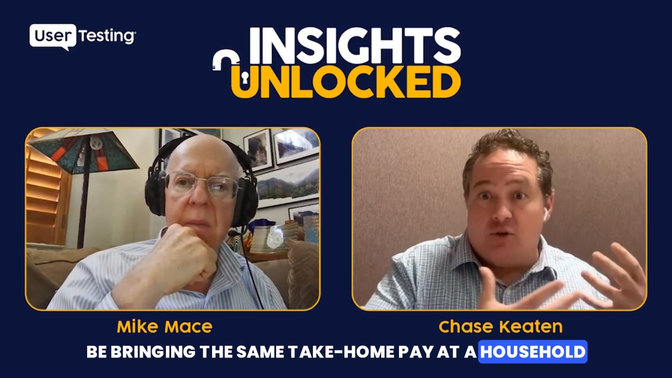
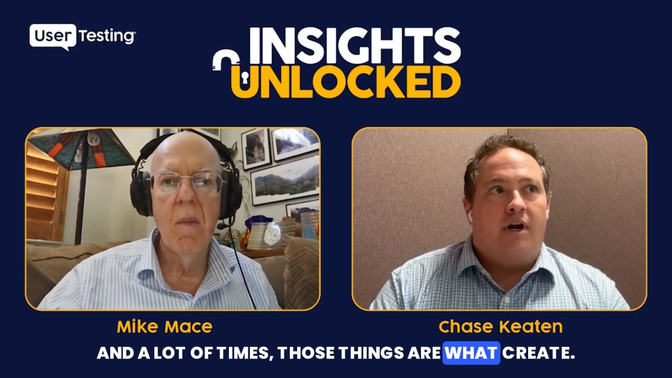
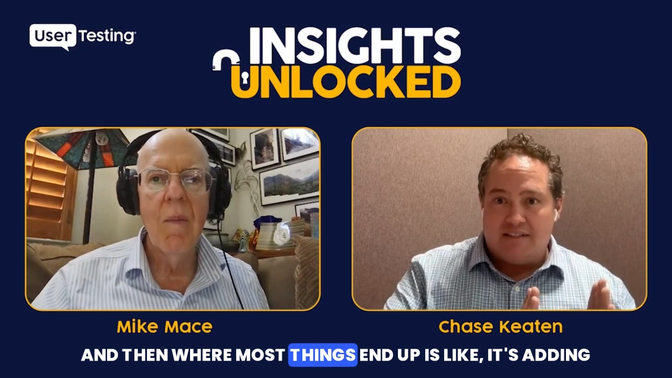
That thought experiment comes from Chase Keaten, senior research manager at Walmart, who recently sat down with Mike Mace, director of solution marketing at UserTesting, for an episode of the Insights Unlocked podcast. The conversation was ostensibly about AI in retail and research. What it actually delivered was a sharper argument: the industry has spent two decades optimizing for usability, and usability is no longer the right question.
ON-DEMAND WEBINAR
Making design decisions you can defend in the age of AI
Two extreme views, and why neither wins
Chase opens with a diagnosis of the room he's spent the last several years standing in. On one side, there's what he calls the "corporate flavored" view of AI—push forward, adopt everything, treat hesitation as friction to be engineered away. On the other, a more human-centered anxiety about jobs, ethics, and what gets lost when machines start making decisions that used to belong to people.
Most people pick a team. Chase doesn't.
"There's a certain inevitability to the usage of AI," he said, "but there's also that personal impulse to ask what's dangerous, what's the cost, what's the trade-off." His conclusion isn't a compromise so much as a discipline: hold both extremes in your head at once, because whenever either one wins outright, progress stalls. Full humanism ignores tools that could meaningfully help people. Full automation, taken to its logical end, is a world with no entry-level jobs left to learn on.
It's a version of professional bilingualism—fluent in the language of speed, fluent in the language of caution, and unwilling to let either one drown out the other.
The builder model has a design flaw
That tension shows up most clearly in what Chase calls the builder model: the idea that one person, armed with a stack of AI agents, can eventually do the job of an entire product team—researcher, designer, engineer, all in one seat.
He doesn't dismiss it. He just points out where it breaks.
Good products, Chase argued, are rarely built by consensus. They're built by conflict—a researcher discovering that customers hate the feature the business already funded, a designer pushing back on a roadmap, engineering saying an idea simply won't scale without an infrastructure rebuild nobody budgeted for. That friction, uncomfortable as it is, is often what saves a product from itself.
AI can be told to simulate disagreement. It just isn't very good at it. "If you ask it to create conflict, what you're really asking it to do is hallucinate about disagreements," Mike said, and it's hard to improve on that line. A machine instructed to invent tension between imaginary stakeholders isn't modeling the messy, self-interested negotiation of a real team. It's guessing at what conflict sounds like.
Chase put it more bluntly still: "The problem is the point." Discovering that an idea is wrong, mid-build, is not a failure of process. It is the process.
Try MCP
Use UserTesting's MCP server to recruit participants, create studies, and launch tests from Claude, ChatGPT, Figma Make, and other AI clients.
Speed's quiet cost
The same trade-off surfaces in design. AI can now take a prompt and produce something that looks, on first glance, like a finished interface—HTML included, tech stack aware. What it can't do, Chase said, is understand the specific context a human designer carries around without noticing: how people actually organize tasks in their heads, which navigation pattern fits this product rather than the last thousand it was trained on.
"Whenever you use AI to build something from scratch, you're almost always sacrificing novelty and context for speed," he said. The result can look right and still be wrong—the correct components, arranged for nobody in particular.
Usability is the wrong scoreboard
This is where the conversation turns from interesting to genuinely useful, because it reframes what companies should actually be testing for.
Traditional software gets judged on a binary: did the user complete the task, yes or no. Agentic AI doesn't fit that scale, Chase argued, because every interaction carries different context, different instructions, different tolerance for a partial result. The real question isn't whether the interface is usable. It's whether the relationship between person and system has earned enough trust to hand over the next decision.
Mike drew out the implication for retail directly, floating the image of a personal "butler" AI that knows a customer's taste, space, and needs well enough to recommend a couch without being asked twice. Chase liked the analogy but flagged the catch built into it: the butler only works if the customer trusts it enough to share the information that makes it useful in the first place. Everyone wants the benefit. Fewer people are ready for the leap of faith that precedes it.
Trust, he noted, is built the way it's always been built between people—through the alignment of words and actions, repeated over time. Software is now being asked to earn something it was never designed to need.
There's a chicken-and-egg problem hiding inside that idea, too. The more context an agent has, the better it can act on someone's behalf—but people only hand over that context once they already trust the system, and they don't trust the system until it's proven itself with the context it doesn't yet have. Somewhere in that loop is the next real design challenge for agentic AI: figuring out what the smallest, safest leap of faith looks like, and building toward it deliberately instead of assuming trust will simply arrive with better models.
GUIDE
Designing AI-powered shopping experiences for the next generation of commerce
The advice that actually matters
For researchers and designers watching all of this from a mid-size company with limited resources and a mandate to "do something with AI," Chase's guidance is refreshingly unglamorous: know your own blind spots first.
Where you're strong, he said, AI's flaws will be obvious to you, and that's useful—you can spot what to fix. Where you're weak, you won't catch every error, but you'll start to recognize the shape of what's working and what isn't. Either way, the skill worth building isn't prompting. It's refining.
"Get comfy with that discomfort," Chase said. It might be the most honest piece of AI advice going around right now — not a roadmap, but a posture. And in an industry still figuring out what to trust, that may be exactly the point.
Related resources
- Webinar: Design confidence under pressure: making decisions you can defend in the age of AI. Design leaders discuss why speed from AI tools doesn't automatically translate to confidence, and what it takes to make defensible decisions in AI-driven workflows — a close parallel to Chase's point about the "builder model" losing the healthy conflict that makes products better.
- Guide: Designing AI-powered shopping for next-gen commerce. A practical guide for retail and ecommerce leaders on closing the "trust gap" in AI-powered shopping, including how to prepare for agent-to-agent commerce — directly relevant given Chase's Walmart context and the episode's butler/personalization analogy.
- Podcast: UX research for AI: building trust in experiences. A Microsoft UX researcher explains why AI experiences need to be judged on trust rather than traditional usability metrics — the same reframing Chase makes when he argues that agentic AI can't be evaluated on a pass/fail scale.
- Blog post: The responsible path to AI-accelerated customer insights. UserTesting's point of view on keeping humans accountable for meaning and decisions as AI takes on more of the research workflow, echoing Chase's caution about hallucinated conflict and unchecked AI output.