


How smarter targeting and flexible incentives are advancing research recruitment
Recruiting and incentivizing the right participants has long been a challenge for researchers—62% of respondents to the State of User Research said that finding enough participants was their biggest recruitment challenge.
Not to mention the risk of getting it wrong can be costly—94% of product features are rarely or never used, according to Pendo.
The good news is that the gap between knowing who you need and actually reaching is narrowing. More on how UserTesting and User Interviews are tackling this challenge below.
Decoding targeting vs screening
First off, it's worth distinguishing targeting and screening.
Targeting is about defining your ideal participant before a single question is asked. It's the upstream decision:
- Who has the lived experience, behavior, context, or perspective that can actually answer your research questions?
- Targeting criteria typically span demographics (age, location, household income), psychographics (values, motivations, lifestyle), behaviors (product usage, purchase patterns, category engagement), and professional attributes (job function, company size, industry).
Screening is how you verify that the participants inside it genuinely qualify — and filter out those who don't. A screener survey probes specific behaviors, attitudes, and intent:
- Have you made a purchase decision in this category in the last 90 days?
- Do you currently use a tool like this at work?
- How involved are you in budget decisions for your team?
Why does this matter? An overreliance on screening to do targeting's job can have knock-on effects, including screeners that are too long or technically-qualified participants who still cannot provide the highest quality insights. Getting both right means your participant pool is both on-target from the start and qualified on arrival.
What advanced targeting actually looks like
Demographics are a starting point, not a strategy. Knowing that your ideal participant is between 30 and 45, college-educated, and based in the U.S. tells you very little about whether they're the right person to help you improve your checkout experience or test a new B2B feature set.
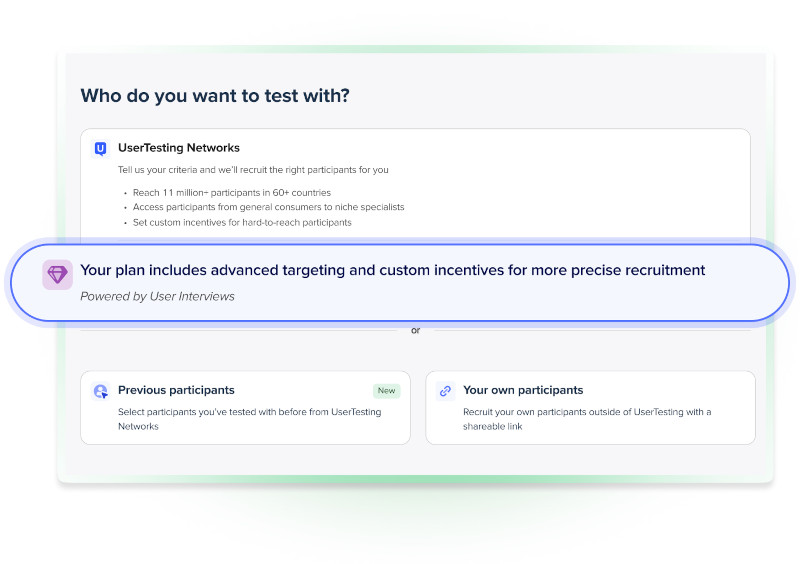
Advanced targeting in UserTesting powered by User Interviews lets researchers define participants across a rich combination of dimensions, shifting the frame from who someone is to what they do/care about. Behind the curtain, the advanced targeting features help researchers:
- Zero in on an ideal audience with rich consumer, professional, and technical attributes
- Create customizable screeners with skip logic, video uploads, and double screening
- Layer in advanced matching & fraud prevention quickly
TRY IT YOURSELF
Want to see advanced targeting in action? Check out this click-through demo
These aren't just demographic proxies, but rather, criteria directly connected to ensuring your research questions are answered. In practice, this can have positive knock-on effects for the following:
- Usability and UX testing: Target by device environment—smartphone OS, browser, computer OS, or assistive technologies and custom settings—so your panel reflects the actual technical context your users are working in.
- Concept and prototype testing: Use Products and Services targeting to reach people already engaging with relevant category services, such as specific streaming platforms, online marketplaces, financial tools, food delivery apps, or travel booking services, so feedback comes from participants with genuine, real-world experience in the space you're testing.
- Market research and audience insights: Go beyond standard demographics with consumer attributes like living situation, neighborhood type, household composition, health insurance type, AI usage, and more.
- B2B research: Professional attributes include job titles, professional skills, seniority, company size, industry, work setting, employment status, and more — including small business owners and gig or contract workers.
The result? A starting pool of participants that's meaningfully closer to your ideal panel before your screener ever runs.
TRY THIS
Unsure whether we can recruit participants for your niche criteria? Check out our Feasibility Calculator
Incentives as a strategic lever
Standard incentive structures work well for broadly accessible consumer audiences. But when your research requires specialized participants (e.g., senior B2B professionals, niche domain experts, people with rare health conditions or highly specific behaviors) a one-size incentive approach creates a ceiling on your reach.
Flexible incentives break through that ceiling. By grounding your incentive amounts to your audience expectations and constraints, you improve both fill rates and quality of participation.
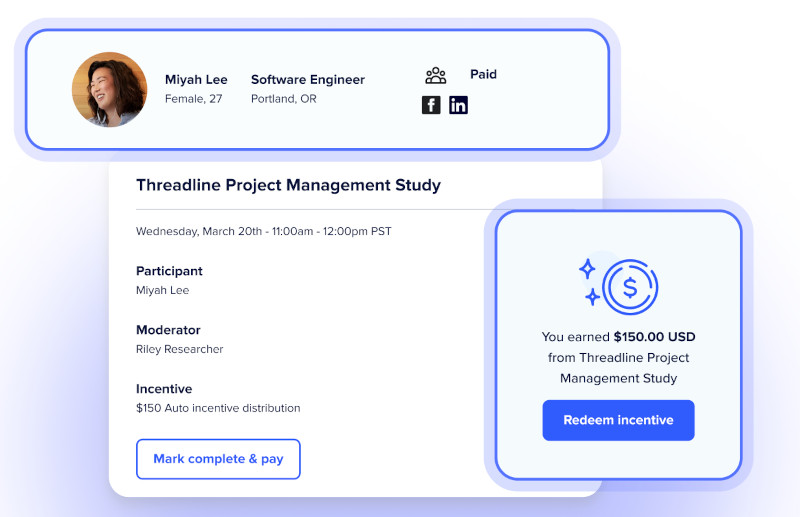
UserTesting now supports more flexibility in how incentives are structured and applied, specifically to help teams reach harder-to-recruit segments without the overhead of managing participant compensation outside the platform. The ability to tailor incentives to audience type is particularly valuable for B2B research, niche consumer studies, and any project where time-to-fill has historically been a bottleneck.
One workflow, from question to decision
The features above can stand on their own, but are far more powerful when they work together inside a single connected platform.
Research teams often stitch together multiple tools and vendors to handle recruiting separately from testing and analysis. That fragmentation creates delays, introduces coordination overhead, and breaks the thread between who was recruited, what they experienced, and the actual insights.
Participant recruitment is now directly embedded in the UserTesting workflow — which means researchers can define targeting criteria, build and deploy a screener, manage incentives, launch tests, and analyze results without ever switching contexts or coordinating across platforms.
- For UX researchers and practitioners, that means less time managing logistics and more time in the work that matters: designing studies, building understanding, and translating findings into action
- For ReOps teams, it means scalable, repeatable recruitment processes with full visibility into who participated and why they qualified
- For product managers and marketing researchers, it means being empowered to reach the right audiences directly within an existing workflow
Practical and tactical approaches to advanced screening, custom incentives
Here’s how you can start implementing these enhanced tools in your research practice:
- Audit your targeting criteria. Are you defining your ideal participant with enough behavioral and psychographic specificity, or leaning too heavily on demographics? The more precisely you target, the harder your screener works.
- Review your screener for over-qualification. If your screener is longer than 5–7 questions or has more than two hard disqualifiers, it may be filtering out good candidates along with bad ones.
- Map your incentive structure to your audience. For any study involving specialized or B2B participants, ask whether your current incentive approach actually reflects the value of those participants' time.
- Identify where workflow friction is slowing you down. If recruiting, testing, and analysis happen in disconnected tools, that gap is a source of both delays and data quality risks.
Explore the platform
Ready to see how UserTesting and User Interviews work better together?