
The Power of Your 'Why': How to Build Stories to Lead and Drive Growth
Jennifer Aaker
General Atlantic Professor at the Stanford Graduate School of Business , Bestselling Author
Studies show that we recall stories much more than data, facts, and figures. We don't remember numbers on a spreadsheet; we remember stories. Stories galvanize — they are the "why" and create shared understanding, engagement, and excitement for employees, teams, and businesses. Storytelling is vital for leaders whose signature stories impact the company's recruiting, retention, and growth.
In this interactive session, Dr. Aaker will guide audiences on discovering and building their signature stories, creating a bank of signature stories, and harnessing stories as assets. Audiences will leave with the ability to curate, craft, and tell stories effectively — and harness stories to lead and drive growth.
Speaker 1
We're gonna have someone who and I am not kidding y'all here, behavioral scientist. So we have now completely brought you all the ways that you can fool every single member of your family. That's what we've learned here at Crafted today. Right?
Good? Okay. But I have the very distinct pleasure of bringing on doctor Jennifer Aker. Come on up here. I believe we're gonna hear some amazing things from you. Welcome.
Speaker 2
Hello. Can you hear me?
It is so nice to be here. I was lucky enough to be able to get in here...
Speaker 1
We're gonna have someone who and I am not kidding y'all here, behavioral scientist. So we have now completely brought you all the ways that you can fool every single member of your family. That's what we've learned here at Crafted today. Right?
Good? Okay. But I have the very distinct pleasure of bringing on doctor Jennifer Aker. Come on up here. I believe we're gonna hear some amazing things from you. Welcome.
Speaker 2
Hello. Can you hear me?
It is so nice to be here. I was lucky enough to be able to get in here a few hours ago, so I got to spend some time, yeah, having high end meet with many of you in the back. The charcuterie was beautiful. It was great to have some drinks and make some fragrance with you.
I'm really happy to be here. I wanted to talk a little bit about this idea of what really matters because beyond being a behavioral scientist, where much of my work really focuses on what is meaningful in life, I'm also a death doula. I've been very influenced by my mother, who has been a hospice volunteer for pretty much as long as I can remember. So I want to contextualize some of my stories and some of the data in a way that hopefully will resonate with you, not just now but in the long run, by just saying we're seeing this world with data patterns that you've heard, certainly I've heard for the last five hours with you.
We see trends where AI is accelerating change in such a way that it makes it feel like it's a little hard to get our bearings.
I actually started teaching the AI class at Stanford with Fei Fei Li in two thousand seventeen and eighteen, and the focus of that class was really on how do humans thrive? How do they flourish? What does it mean to be human? Fast forward ten years with LLMs and generative science and other methodologies that the students start to play with, these things are even more important now.
We're also saying that trust is diminishing, and that's not just trust in our systems, in our organizations, but it's trust in our leaders. What we do trust are people that where you feel that emotion, where you feel that human connection.
And you also see these large scale macro effects with well-being. That well-being has been on the decline for the last sort of, you know, certainly fifteen years among our teens especially, especially our teenage girls, exacerbated by technology, but also this sense of what is meaningful in our life.
So I started thinking about some of these issues, as I said, as a young girl, what really is a life of purpose?
When I'm the oldest of three girls, and so we would talk about these things around the dinner table, what really does it mean to have a life of meaning and fulfillment, this idea of what really matters.
So this is my mom.
There she is. And so she would talk about what people wish for in their last days of life because as a hospice volunteer, that's your job, to listen, to hold their hand, and to see what is it that you can do. Sometimes it's just listening, and sometimes it's actually trying to make their wishes sort of come true. And so around the dinner table, we would talk about what those wishes are, who were the people that died in ways that were really peaceful and joyful, and who were the people that passed on with regrets or wishes, because we're a fun family and that's what fun families do.
So we would talk about this and I remember thinking these people that seem to have not done enough, didn't have that sense of fulfillment, what were they chasing or what were they not? And my mom would share with me these ideas around people would often talk about, I wish I was more authentically me.
I wish I was more me. And then they often wish they had lived a life that was just not so serious. They could do very serious things but not take themselves so seriously, been more generous with their laughter. And remember, this is one of their last, most serious kind of moments in life.
And love, I wish I had the chance to say I love you one more time.
And I remember asking my mom, you know, who are these people that they wish they'd said I love you more? And it wasn't always like their spouse or their kid or their parent. It was often, more often than not, like the second cousin that they hadn't talked to, or their best friend from high school that they just had a falling out with and just never talked to them again. So a little side note, think about who that is for you, and just like after this, just text them, I love you, or anything.
So what I wanted to do is basically unpack those three beats and argue that a life of purpose and meaning is really built around these ideas of emotion. And in a world of automated technology, how can we potentially take this moment and deepen our purpose, our sense of purpose.
Now, as I said, I teach this AI class, and so I just finished teaching it. We had Demis come in on Friday. Demis is the CEO of Google DeepMind. And so I brought two students in, and we're talking to Demis, and I give him a few of the cartoons that we show on the first day that the students deeply, deeply kind of feel. They feel this.
They feel that.
So what are we going to do with our time? We're going to talk a lot about what we're going to do with all of that extra time.
And so in this class, we really think about what does it mean to have humans flourish? What does well-being mean? What does meaning in our life? In fact, one of my students, the first day of class, we always ask them, you know, what are you what are you gonna why are you taking the class? And one of them said, I'm taking this class to better understand what is meaning, what is life, and what creates a meaningful life. And they got an A.
But it starts us off on this on this kind of journey together. How do we design systems that deepen our sense of purpose? And the last panel said it I think really beautifully, how do we use AI and human creativity and ingenuity and judgment and taste and open ourselves up in ways that are working with high performing teams agents in ways that are actually fulfilling and creative, not just productive? How do we do it in a way that strengthens our authenticity and our sense of boldness with humor and even love? So that's what I'm gonna talk to you about in the next sort of thirty minutes. If you had three things to remember based on this, I really want you to think about what does it mean to be authentically you? Now you could argue that the term authenticity is overused, but I think this story, really helps to kind of solidify what it might mean for you.
So when I was training for becoming a death doula, which is different than a hospice volunteer, but it's still a very privileged position to be with people when they cross over or as start the crossover process. And in that training, there was a story that I learned in one of my classes about Jesus. And Jesus had heard that if you die, the divine asks you a question. So the divine comes down and asks you a question.
She wanted to know what the question was, and so she managed to die. She came back to life, and her friends surrounded her, and they said, did you get asked the question? Did you get asked the question? And she said, yes.
Yes. I thought it was going to be how much did you achieve in life? But it wasn't. And her friend said, well, what was it?
She said, I wish it was how much did you learn in life? But it wasn't. They're like, okay, what was it? And she said, it was Jesus.
Why weren't you more Jesus?
And I think that's such a great story to help us all redefine what success means for us. Are we being the best versions of ourselves in our life, and are we evolving in that way?
Authenticity means living in alignment in a way that feels balanced with your values that are truest to you. Now what we show in our class is that many people feel like there are certain people who are authentic versus not, but it's actually not a fixed trait, It's quite a practice. And the best way that we have found empirically that actually allows people to know what is authentic to me is to understand your signature stories.
So your signature stories, I define as intriguing, involving, authentic stories that have a goal. There's a reason you share it. Most people feel like stories are long, epic things, but they're actually quite short.
Ernest Hemingway was once known to have shared the first six word story. He wrote, baby shoes for sale, never worn.
So on the first day of our Power of Story class, we have everyone take thirty seconds and just write down a six word story about themselves.
So here's one of them not quite aspiring to be quite.
Tonight he packs, tomorrow I pine.
Married the wrong guy, fixed it.
Getting old ringtones piss me off. So these don't have to be like big epic stories, they could just be like small little moments that you're kind of sharing. So I'm gonna have you also take thirty seconds and just share a six word story. Write it down on your phone or on a piece of paper, thirty seconds, write down a six word story. One tip, think before and after. So it could be before Crafted and after, or it could be when you were a child and now. So have some sort of transformation.
Okay, as you're finishing up, I'd like you to just take another thirty seconds and quickly go around the table and share your six word story. And if you're all by yourself at a table, grab a couple of others at another table. But you have thirty seconds to quickly share your six word story at the table. Go for it.
Alright, coming on back.
Did by the way, did anyone hear like an epic six word story? Did anyone hear like a really good one?
You heard one? You've been volunteered. Congratulations. You get, I will get you a gift. It will either be a car or a signed book, like either one.
Okay. Will you or or brownie. Oh, but there's so many gifts. You're so excited.
Share your name and then six word story and I'll repeat
Speaker 3
it. My name is
Speaker 2
Raja.
My Sawed love.
Speaker 3
Found a friend.
Speaker 2
Found a friend. Happier. Happier. Oh, it's beautiful. Thank you so much. You get a car and a book and a brownie.
Come see me afterwards. My email's here.
What we do in our class, when we have people share those six word stories, they feel like they know each other better. It's different than saying these are six traits about me or this is my last job. It shrinks the distance and it doesn't take that long. So think about those for warm ups, for meetings to start or end, even six word stories of what you did this weekend.
Madeline Albright, Secretary of State Madeline Albright came into the class five years ago, and we had her list her top ten signature stories, six words or less. She gave them to the students and said, which one do you want to hear? So I remember one of my students said, I want to hear the Russian foreign minister story. So she started and she goes, okay.
I just became secretary of state.
I'm starting to my first negotiation with the Russian foreign minister.
I find out he had bugged the US State Department right before the negotiation. So she didn't know what to do.
So she decides to go in, walks in, wearing this bug pin. Like, it was so big. Like, look how big this bug pin is. Like, it's like a five inch bug pin. And she shares how looked at the pen, looked at her, he looked at the pen, he looked at her, and he could not help but smile. Like, he just breaks, and all of the tension in the room just dissipates.
And she shares how he then negotiated and so productive because he wasn't talking to her as Secretary of State Madeleine Albright, but rather as Madeleine. And that there was a change in the way that they had that conversation that allowed it to be more human and more authentic.
Now, how does this show up in your work? When you go back, I don't know if you're going go back to work on Friday or Monday. Whenever you go back, the question is, what are you going to do with this? I wanted to end with one story for this section, which involves the NBA.
I gave a talk there many years ago, and it was actually not dissimilar to this, except for every single one of these tables, there's like ten people at each table, and they all had a team. So you guys were the Warriors, you're the Lakers, you're the Celtics, etcetera.
And so, you know, it's the owner, the president, the vice president, made me a couple of players, and asked them the same question I just asked you. So they also wrote down their six word personal story, but then they did three more questions, and I only gave them thirty seconds.
The first is, what is your team story?
So the warriors are all writing down, what is our team story? We're like the underdogs at the time. They were like champions, and so it was hard to be an underdog there. But what is that story?
The second one was what is your customer as hero story? Now in the case of basketball, their customer was the season ticket holder. How are you making that mom or that dad or that small business the hero of their own story by being a season ticket holder to the Warriors. So then you write down that six word story. Last question was growth story. Imagine you in three years, what is that transformation of the Warriors, the Celtics, Lakers over the three year time frame? What is that arc?
So they did that thirty seconds, shared it in one minute. Everyone was kind of laughing, and Adam Silver, the commissioner, came back after this and said it was the most efficient, impactful exercise they'd done, as long as memory serves, because it was so clear that the high performing teams all had the same story.
And the low performing teams, they all had very different stories. All ten stickies had very different kind of arcs or ideas. There was no alignment. So ask your team, what is our story? What is our growth story? What is our customer's hero story? How are we making, you know, Wells Fargo, you know, them the hero of the story, or the Wells Fargo clients and customers the hero of their own story?
I love the Blue Cross. I don't know if they're here in the room, but I did a bunch of research on all of you and worked with user testing to learn more about you and love the story that Alberta Blue Cross did as they started to unpack these authentic user stories, and then how they implemented it at at Blue Cross in Alberta. So know your signature stories, know your customer or client stories, and then just create a story bank. Collect those six word stories and mine them using AI to pull out through lines, to pull out arcs, and if you need any help, let me know. I can give you lots of cases.
The second is humor.
Humor connects in ways that people do not understand, and it is not about being funny, it is about looking at the world in a different way, living life on the precipice of a smile.
Now here's the problem. When we ask people with Gallup, did you smile or laugh a lot yesterday? And we did so with one point four million people.
People say yes when they're seventeen, eighteen, nineteen, and it starts to go down precipitously dropping around twenty three. Right when people go to work and start to take themselves very seriously.
And it doesn't increase, by the way, until like eighty, so that's horrifying.
Average life expectancy is seventy six, so you're missing very funny years. And we know it's worked because if you ask the same question on weekends, you get a huge scaling effect. People are smiling and laughing, just not on weekends.
So I'm going to share a data, a little palette cleanser. There isn't any data in it, but because I'm from California, I'm just going to bring a little bit of it to you. So we'll just play the video.
Speaker 4
Next on The Californians.
Speaker 3
I'm glad you came over to Evan.
Speaker 4
Why do?
Speaker 3
Maybe you should get going before Stuart gets home.
Speaker 4
Right, right.
I was thinking I'd take Candy View Drive over to San Vicente and then make
Speaker 5
a left and go to four or
Speaker 4
five North.
From there, just get off from
Speaker 3
Mulholland.
Totally like that.
Hey, honey.
I brought up some tangerines. This guy was selling them on the off ramp over by the two.
Devin?
Speaker 4
What are you doing here?
Speaker 2
Stuart, why are you hemmed so early?
Speaker 3
I skipped Wilshire and took Beverly over to Santa Monica and took that all the way up.
Speaker 4
Hey, Stuart. Yeah. I just came over to fix the speakers out, but the outside speakers on the patio, I think they sound pretty good.
How was work?
I think you
Speaker 3
should go home now, Devin.
Speaker 2
There's nothing going on, Stewart.
Speaker 3
You should go home. Get back on San Vicente, take it to the ten, then switch over to the four zero five North and let it dump you out into Mulholland where you belong.
Speaker 2
Sure. At this time of day, it's gonna be jammed. Are you a crescent?
Speaker 3
Just get on the chin and get out of here.
Speaker 2
Okay.
So what is happening here is most people think that humor is a psychological phenomenon, but it's actually a neurological basis.
So what's happening is when we laugh together, our brain releases this cocktail of hormones. So it releases endorphins, giving us a feeling similar to a runner's high. It calms down at reducing our cortisol, so kind of similar to like five minutes of meditating. It also releases dopamine, which is the same hormone released during certain types of physical touch.
So as far as our brains are concerned, laughing together is like exercising, meditating, and having sex all at the same time. But HR is fine with it, so risk is reduced.
So it has this great neurological benefit, and the question is why do we not use it that much, especially since we know it's the best medicine.
I mean after actual medicine, laughter is sort of this health boost that increases all of these hormones that are so healthy for us. I would say two things. One is know your humor style.
Again, this is not about being funny, this is about understanding your own style and that of others. So I'm gonna ask you a couple questions, and I'm gonna have you then raise your hand with what style resonates the most with you personally.
So over the last ten years, my colleagues and I have done countless studies, millions of people across cultures, asking people their humor style. There are stand ups, and they are loud and boisterous. They're bold, irreverent. They're great with roasts. They tend to be more extroverted. And then there are sweethearts, and they are understated and warm.
Keep it PG thirteen. They would never really think of themselves as funny, but they are. If you watch how they use humor, it's often used to uplift or bring people together.
Then there's snipers. They're edgy, sarcastic, deadpan delivery. It's hard to make them smile, but when you do, you feel great. And then there's magnets, they are charismatic and more extroverted.
They're uplifting and expressive. They're a little bit sillier. They might have been told, alright, calm down on the humor. But if you look at how they use it, it is more physical, it is a little bit more silly, and it's very inclusive.
So, and you might have multiple styles. If you have multiple styles, you can raise your hand multiple times. Raise your hand if one of your dominant styles is a stand up.
Okay, we've got a few in the front, they usually sit in the front. Alright, sweethearts.
Okay, we've a few more sweethearts. Snipers?
Oh, a fair number of snipers and then magnets?
A fair number of magnets. Okay, fantastic.
Each one of these are really important, not just because once you understand your humor style, if you can be more generous with your laughter, but you can also start to understand when you use humor and it doesn't work, what are the downsides? So for example, stand ups and snipers, because they tease as a sign of affection. So I'm teasing you, that means I like you, but it doesn't always land that way. You know, you can inadvertently alienate or offend people.
But what you understand, if you're dominantly a stand up or sniper, you switch to one of your secondary styles in context where you need to read the room or you need to have a different goal or you don't know the audience.
On the other side, we've got magnets and sweethearts who, because they're so good at being inclusive, they're at risk to over index on self deprecation. So self deprecation is this really powerful tool at high status levels, but at lower status levels, or if you don't know the audience, self deprecation can boomerang. So understand the pros, understand the cons, and then ask your team, what is your humor style? Because it's such a good indicator I'm inviting humor here at work. We're at work the large majority of our lives. It's not the place not to have joy, not to have laughter.
The second tip here is to just tell truth with levity. This is not about being a comedian. This is about looking at the world in a different way, and the best way to do this is just look for truth and then see if you can share it with a little levity. So for example, comedians do this well.
This cartoonist is one of my favorite. I'd like you to raise your hands if you are. I brought an extra European outlet adapter. If you need one, raise your hands if you're that person.
Okay. If you're not raising your hands, I want you to look at the people raising their hands and then travel with them.
Okay.
Yeah, hire, hire. Keep them up. I'm taking names.
Or, for example, I'll just have you read this.
So just truth with like some levity. Or for example, Sarah Cooper came to our class, she's a comedian, and drew this.
Delta's new CV chart, economy comfort, economy, economy discomfort, economy agony, economy to the reckoning, where is your God now economy, saints den economy, and then just poop.
There's even a show called lie detector where they hook up, celebrities to, like, a lie detector and then just ask them questions, and it is almost always inevitably funny, just sharing the truth. Here's Hussain Minaj.
Speaker 6
Do you think your parents have a favorite child? Yes. Well, who is it? A hundred percent.
So mom I'm my mom's favorite child, and Ayesha's my dad's favorite child. Does that hurt your feelings? No. I love it.
You know, we all know that, like, your mother's love is the thing you vie for the most. It it has the most, like, value. You know how, like, it's like it's like USD, whereas a father's love is like Bitcoin. It's just, like, esoteric and, like, does it matter?
Like, who we don't even know if it matters.
So you like your mom more than your dad? Hundred percent. Yes. Way more.
Speaker 2
He's telling the truth.
Speaker 6
A lot more.
Speaker 2
Okay. So the question is, like, how does this show up at work? One of my friends is well, actually, first of all, I wanna give someone a shout here. I don't know if I can raise hands, but I loved NRG Energy's campaign, what they did, I don't know if they're here, but just so you know, what they did was they had higher performance when they brought in agent Hugo that left Reliance competition in a very differentiated way. They found key insights that were discovered by Reliance marketing and advertising team when they took this approach with a little bit of levity. And so much of this was about basically these new associations with some fun, with some differentiation, with a little bit of levity associated with it.
I'll give you one more example of how you bring this to life, not just as a brand or a company, but as a leader.
Conor Demigneoman is one of the CEOs that we work with, and he was starting his role at Merit America, which is the largest, I think, nonprofit in the area of employment space.
And in during COVID, so it was end of March twenty twenty, he ran his first ever all hands meeting. He was scared. All hundred faces on the Zoom were scared. And he opens up the off-site saying, you know, this is who I am, this is what I want us to understand. Five minutes in, he passes the baton to his co founder, accidentally leaves his screen share on, goes to Google and types in, as everyone is petrified for him, he types in things inspirational leaders say during hard times.
So he's typing that in, and then he comes back to the Zoom and he just goes like, I want you to know you can trust me.
I am here for you.
Here is my email. So what happens? So there's this sea of laughing faces.
We know from the research that leaders with a sense of humor are about twenty eight percent more motivating and admired. Their teams are fifteen percent more engaged and satisfied. When asked to solve a creativity challenge, their teams are twice as likely to actually solve it. And that's not even a good sense of humor, that's just a sense of humor. The bar is so low.
Alright, so don't look for what's funny, notice what's true, and then just add a little bit of levity.
Know your humor style, tell the truth with levity, and live life on the precipice of a smile.
I wanted to end with love.
This idea of love might sound, you know, sort of unusual in context of companies and and sort of corporate America, but there's research in the body of work on death that shows that like Jesus, there are people that die and then they come back. Ninety five percent of them report having a life review.
A life review is where your life goes by, like, within a second. And it's all these moments, and they're not all happy moments. There's some moments where you thought, I could have done better. They're beautiful moments, but not all happy. But here's the thing, you experience them as if you were the person in the room with you. So if you were not kind to the barista at Starbucks, you would re experience that moment as if you were the barista.
Humans are wired for a connection, and we're wired to understand what other people feel, and this has such a profound implication, underscoring what is really important in life. How are others feeling when you leave the room?
I define love as this idea of seeing and valuing each other. It's what creates a sense of belonging and safety and adventure, and when people feel seen, they bring their best selves and boldest ideas to the table.
I often say that people want to be valued members of a winning team on an inspired mission. And if you get every one of these words right in your team, love exists. I feel like I'm a team.
I feel like I know what we're winning or where we're going. And if we're not winning, why are we not winning and how are going to get to winning? We know what sort of is our inspired mission.
We know exactly how others feel valued.
I've been lucky enough to work with Stephen Curry over the last twelve years, mostly on organizations and family charities, not on basketball. But he often says, we win when everyone touches the ball.
We win when everyone touches the ball, when everyone knows their role, and we're in flow, and we're in alignment, and we know that people want to be these valued members of a winning team on an inspired mission. And so the question is how do you make that happen for you? One of the things we do actually before we do a session is talk a little bit about love. What is a moment of love for your family, for your organization, for your team?
And we say how does this show up at work? We often talk about what does it look like to make an experience beautiful, not just something beautiful, but an actual experience beautiful where people feel aligned, they can have hard conversations, and they leave feeling love.
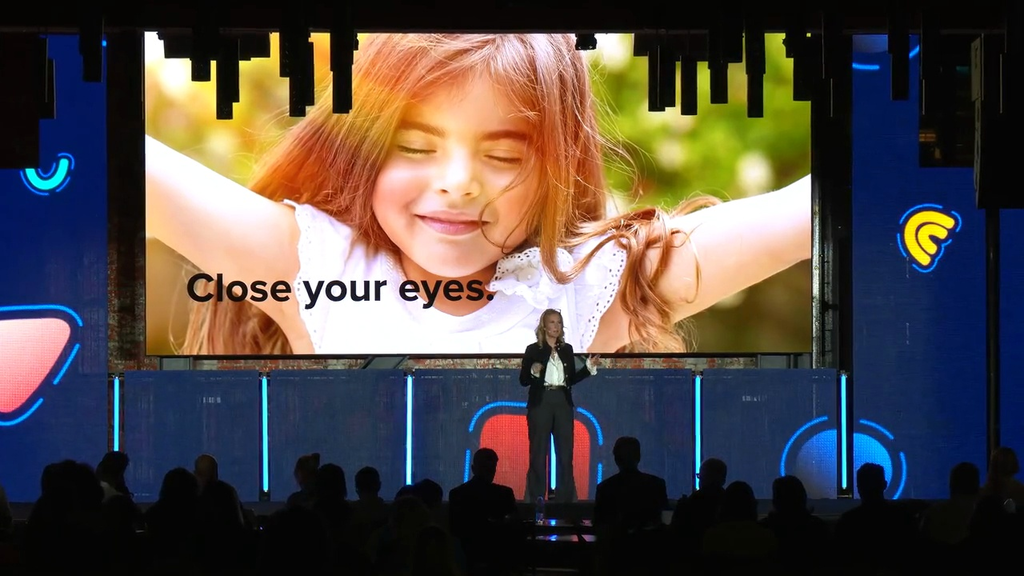
So one of the exercises we do at the beginning of our sessions is a very simple meditation, and I'm just gonna end with you doing this with me, as a way of priming a set of ideas that hopefully will come after. Alright, so everyone close your eyes.
What I'd like you to do is take a slow breath in, hold it at the top, and then a slow breath out.
And then hold it at the bottom.
And as you breathe in and keep box breathing, I want you to imagine someone who loves you deeply.
I want you to imagine their eyes, their smile.
I want you to notice how you feel right now.
In your body, you feel seen, known, loved, and I want you to recall a beautiful moment you've had with them.
Where were you?
What were the colors like?
How did you feel?
I want you to let that feeling stay in your chest for the rest of today and know you can tap back into it at any time.
Now open your eyes.
So in our research, when we do that just for one minute, we find that people who do that meditation versus meditate on a signature, strength or do any other type of meditation, they act in very different ways. They define happiness much more as something that's meaningful and purposeful.
Kids trained on this loving kindness meditation give away about twenty three percent of their stickers to other kids.
People give up their seat at a in a bus to someone who needs it. People act in very different ways, and it impacts the way that you work with your team. Certainly it does for Stefan, but even these other individuals or leaders where you ask them to understand what does it mean to love your customer, your teammates, and even your vision for growth. We find that it's often quite contagious and those ideas have impact in ways that are really creative, productive, and defining of success for that team. I love Wells Fargo's recent focus. John said that user testing with them was able for them to move from the human mind to the human heart, and the insights unlocked in that mindset shift, I think, are profound.
So, this insight can be lived at work by creating a culture where people feel like they're valued members of a winning team on an inspired mission, by making appreciation and recognition visible and routine, and then by using AI not to depersonalize work, but as many of the prior speakers said and you were talking about during break, in a way that augments humans so performance and purpose can rise together.
Remember that love can be communicated in small ways.
Instead of saying thanks, say I loved your ideas.
Instead of saying what do you do? Ask what do you love to do?
Or even just simply noticing someone, seeing them in their eye, holding their hand perhaps, and making sure they feel seen and valued.
So that brings me back to my mom.
Recently, my mom's best friend, my second mom, Marty, passed away, and she had gotten an aneurysm while she was swimming in a pool near us, and so we, we were two families, best friends, we all came to the ER, my mom walked us through how to say goodbye to Marty, and we all held her hand.
We told stories that made us laugh, and even though she was in a coma, felt like she could hear us. We touched each other, we held hands, we breathed with her as she was breathing, and then we knew that singing her favorite childhood song actually brings a sense of peace because the last sense to go when you pass on is a sense of hearing. So he sang This Little Light of Mine, I'm gonna let it shine.
And we're tone deaf, so it was objectively awful.
But I think she loved it because she passed on with this little smile on her face.
I think at this time AI can't replace that sense of human connection, but we can take this moment of time and understand what is truly important for us and when do we feel most alive. And these regrets of the dying, they're not warning, but they're instructions for all of us to live with more authenticity and boldness and humor and love.
And what I hope you think about is this opportunity right here, right now, to use technology as you go out and live and use it in ways that are more human.
So understand your signature stories and ask others for those.
Live on the life of the precipice of a smile, and make others feel seen, make others feel valued, And I am so, so appreciative of my time with you. Sending you love.