


The design industry has a confidence problem. Here's what AI is getting wrong

Every major tech company just shipped a design feature. Most of them are solving the wrong problem.
The industry has spent the last two years racing to make design faster — faster ideation, faster generation, faster handoff. And by that measure, it's working. AI tools have genuinely removed barriers, made visual thinking accessible, and compressed timelines that used to take weeks into hours. That's real progress.
But speed isn't the same as direction. And right now, a lot of teams are moving very fast in the wrong direction.
The trap, as I keep seeing it, is forgetting what a design artifact is actually supposed to do. It's a communication tool that brings people onto the same page, it becomes a spec, and most importantly, it's a vehicle for getting feedback from the people who actually matter: real users. When we get seduced by how good AI-generated work looks, how polished, how plausible, how done it seems, we often skip that last step where outcomes fall apart.
So I sat down with UserTesting’s Principal Content Content Marketing Manager Nathan Isaacs to answer the questions I keep getting asked—and the ones no one's asking yet.
ON-DEMAND WEBINAR
Defensible Design: Making Confident Decisions at Speed
On AI design tools
Nathan: Everyone's talking about AI design tools right now. What's your honest reaction?
Jason: These tools matter, full stop. At their core, they're picture-making machines, and getting people looking at the same picture is still how great work begins. What's genuinely new is that the barrier to entry is gone. Anyone can now participate in the creative process, initiate ideas, and produce outputs that are good enough to react to. That's not nothing. But here's where it gets interesting for working designers: the better your vision, the more frustrated you'll get. If you're a tastemaker with something specific in your head, you'll spend more time wrestling with the tool than you would have just doing it yourself. Non-designers? They see the first output and think it's incredible. Which is fine, until someone has to decide if that output is actually right.
The real question these tools are forcing us to answer is: what is a design artifact actually for? It's three things:
Getting people on the same page
Becoming the spec
Getting feedback from real users. The trap is stopping after the first one and calling it done.
ON-DEMAND WEBINAR
Design Confidence Under Pressure: Making Decisions You Can Defend in the Age of AI
On who’s winning the platform race
Nathan: OpenAI, Google, Figma, Adobe—they're all moving into AI design generation. Who's actually getting it right?
Jason: Figma has the obvious initial advantage, they're working backwards from professional-grade tools, so that depth is in their DNA. And critically, collaboration was their original unlock. And this is where the new entrants really need to close the gap. They need to figure out how to let teams work together in it by giving feedback, riffing in real time, building shared understanding. Today, “vibe coding” is effectively a solo sport, and that’s not going to fly.
The specific craft controls like UI polish controls aren't hard to replicate. Any well-resourced team can get there. Once you combine that level of specificity with a canvas and real collaboration, the workflow becomes something Figma and others will struggle to compete with.
My honest answer? Nobody's fully getting it right … yet.
On vibe coding
Nathan: What does vibe coding mean for designers specifically?
Jason: It's the biggest unlock designers have had in years. For the first time, you can go from an idea to something you can actually feel: how the experience unfolds, real interactions, micro-moments that prototypes have always hidden. That matters enormously, because some of the best design decisions live in the details: how a page transitions, how a scroll bar behaves, how something moves. You couldn't feel that before without a dedicated design developer. Now anyone can.
But the real opportunity is what happens when you take that working prototype and put it in front of a real user. Going from idea to testable experience at that speed, with plausible data, real flows, genuine interactivity, and then feeding that feedback directly back into the process? That's a fundamentally different way of working.
One caveat: vibe coding is still largely an individual activity. It's fast, it's powerful, and it's genuinely exciting, but it's not yet how teams build products together. That's the next frontier that every team is now trying to figure out: how do you get the benefits of vibe coding as a team, at scale?
On the speed vs outcomes gap
Nathan: Our own research shows 91% of designers are moving faster but only 15% say outcomes are improving. Why isn't speed translating?
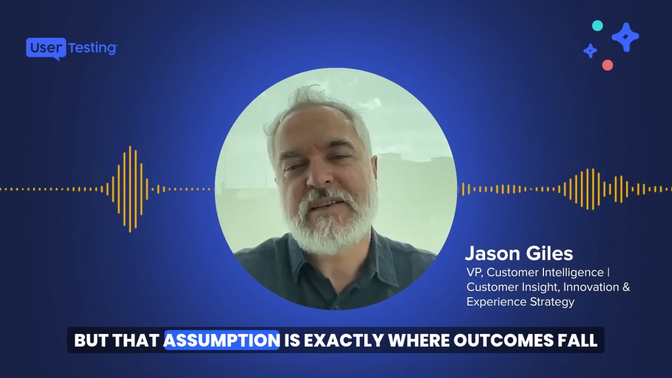
Jason: Two things are colliding. First, the pressure to ship is relentless and teams are producing outputs and moving on before they've had a chance to evaluate whether those outputs are actually good. There's no breathing room to ask the hard questions. Second, AI-generated work looks so polished, so plausible, so done and it creates a false sense of confidence. It's easy to look at something that renders beautifully and assume it's ready. That assumption is where outcomes fall apart.
What's missing is a feedback loop with real humans, running at the same speed as the new pace of work. I think about it like evals in AI development—you run tests consistently to make sure the model's outputs are still good, because these are non-deterministic systems that drift over time. Humans are non-deterministic too. Customer attitudes shift, behaviors change, expectations evolve. You need that signal continuously, not just at launch.
That's the opportunity for platforms like ours: not just providing feedback, but embedding that feedback loop into the way teams already work, so confidence is built in from the start and not bolted on at the end.
On what design leaders should do now
Nathan: What should design leaders actually be doing right now—not eventually, right now?
Jason: Start by accepting that this isn't a phase. Things are changing, and they're not changing back. Once you come to terms with that, you can actually show up for your team, acknowledge their fears, and then show them a path forward. That's the job.
From there, it's practical: write things down. Define what good design looks like in your organization: your principles, your rules, your design system, your accessibility requirements. In the past, you could wave your hands and walk someone through it. Now you have to codify it, because the "team" increasingly includes agents that can't read your mind. Doing that work helps your human designers and your AI tools equally.
"It was never about the screens. It was about the way you're thinking—understanding customers, creativity, understanding technology. You have to lean into that."
Then look at your gates. Where are your human-in-the-loop checkpoints? What evidence do you require before something ships? Those answers depend on your organization's risk tolerance, but you need alignment on where you’ll maximize AI speed, and where it’s important to take a breath.
And finally—think hard about how you're developing the next generation. Design critique still matters. It just might look different now.
REPORT
Defensible design in the age of AI
AI is speeding up design—but not confidence. Learn how 183 designers navigate risk, validation, and accountability in 2026’s AI-driven workflows.
On the future of the designer’s role
Nathan: Is the designer's role fundamentally changing, or is this just a new tool cycle?
Jason: It depends entirely on how you've defined your role. If you saw yourself as a producer of screens and flows, yes, that's changing fast, and it's going to be a hard transition. But if you understand design as aligning people around the right problems, channeling the customer voice, making judgment calls about what to prioritize and what will actually resonate—none of that is going anywhere.
If anything, this is the moment design has been waiting for. The tools are getting out of the way. What's left is the hard, human work: understanding people, synthesizing complexity, knowing what good looks like and why. That judgment can't be automated.
"This is the moment for design where the tools get out of the way—and it's a reminder of why you were a problem solver to begin with."
We'll land somewhere that feels different and familiar at the same time. New titles, new workflows, new collaborators with some of them being agents. But the fundamentals of how you build something people actually want to use? Those haven't changed since the beginning. And they won't.

Judgment is the new differentiator
The teams that will look back on this moment as a turning point are the ones that slowed down just enough to ask whether what they built actually worked. Speed is table stakes now. Judgment is the differentiator.
That means knowing when to ship and when to test. It means writing down what good design actually looks like for the agents and tools that are increasingly doing the work alongside them. And it means remembering that design was never about the screens. It was about understanding people, aligning teams around the right problems, and delivering things that customers actually want to use.
None of that has changed. The tools have. The pace has. But the reason design matters, that's exactly the same.
If you want to go deeper on how design leaders are navigating this shift, we recently hosted a live session on building design practice for the AI era. Watch the webinar here.
PODCAST