


When human judgement becomes the real design advantage
When AI can accelerate so much of the work, where do humans create the most value?
At UserTesting’s Crafted conference, Liz Miller, VP and Principal Analyst at Constellation Research, led a conversation with Jason Giles, Vice President of Product Design at UserTesting; Eliel Johnson, AI design leader and former VP of Design at CVS Health; and Jessa Parette, Head of Design at Byte by Yum!. Together, they explored one of the biggest questions facing design, research, and product leaders today.
The answer that emerged from the panel was clear. AI may change how work gets done, but human judgment, curiosity, accountability, and customer understanding are becoming more important—not less.
You can watch the full panel discussion at our Insights+ page. Here are the highlights:
AI is giving teams time back. The question is what they’ll do with it.
For many professionals, the first reaction to AI is fear.
What happens when part of the work gets automated? What happens when the tasks that used to take hours or days can now be completed in minutes? What happens when AI can generate prototypes, summarize research, draft reports, or produce outputs that once required entire teams?
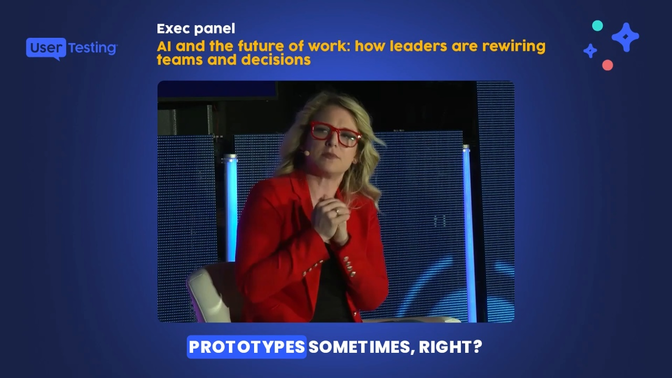
Jessa Parette reframed that anxiety in a way that resonated across the room.
"You can either look at that and go, ‘Oh my god, thirty percent, forty percent of my job just got automated.’ Or you can go, ‘Oh holy crap. I just got forty percent of my time back."
That shift in mindset matters.
The most successful professionals won’t be defined by the tasks AI can complete. They’ll be defined by what they do with the time AI gives back.
For designers, researchers, product managers, and customer experience leaders, that means moving beyond execution alone. It means spending more time on the work that requires human context: identifying the right problems, asking better questions, reducing uncertainty, shaping strategy, and making decisions that serve both customers and the business.
AI can help teams move faster. But it can’t decide what is worth moving toward.

Try MCP
Use UserTesting's MCP server to recruit participants, create studies, and launch tests from Claude, ChatGPT, Figma Make, and other AI clients.
Don’t outsource your right to decide
One of the strongest themes from the conversation was the difference between execution and accountability.
AI can execute. It can draft, generate, summarize, analyze, and recommend. But it cannot own the consequences of a decision. It cannot understand organizational context the way a human leader can. It cannot carry responsibility for whether a product experience is trustworthy, inclusive, ethical, useful, or aligned to the needs of real people.
Jessa captured that distinction in one of the panel’s most memorable moments.
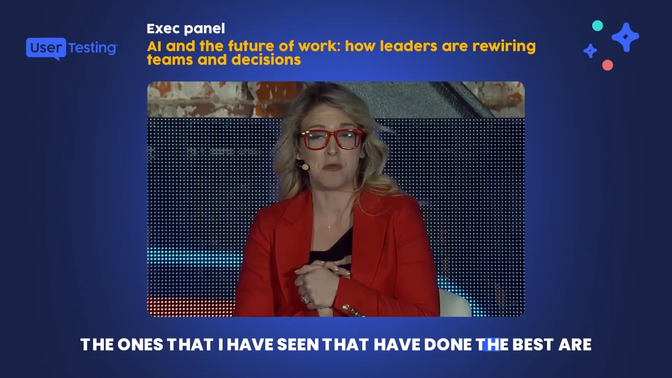
“You can outsource execution. AI just did that. Don’t you dare outsource your right to decision.”
That line cuts to the heart of the AI opportunity.
The organizations that create the most value with AI won’t be the ones that hand over decision-making to algorithms. They’ll be the ones that know exactly where AI belongs in the workflow—and where human judgment must stay firmly in the loop.
As AI accelerates execution, the ability to ask the right questions becomes even more valuable. Teams need to know when to move quickly, when to slow down, when to challenge an assumption, and when to bring the customer’s voice back into the conversation.
That is especially important in design and research, where every interface, disclosure, workflow, recommendation, and interaction can shape how people experience trust, power, and clarity.
AI can help generate the output. Humans still have to own the outcome.
CRAFTED SESSION
AI and the Future of Work
Watch the full Insights+ session to hear Liz Miller, Jason Giles, Eliel Johnson, and Jessa Parette explore how AI is reshaping decision-making—and why this may be the moment for design, research, and customer-centric teams to lead.
This is the moment for design and research to lead
For years, designers and researchers have asked for a seat at the table.
Now, the table itself is changing.
As AI reshapes how organizations build products, make decisions, and interact with customers, leaders need people who can bring clarity to ambiguity. They need people who can surface real customer needs, identify risk, challenge assumptions, and help teams make better decisions under pressure.
Jason Giles argued that this is not a moment for design and research teams to shrink back. It is a moment to step forward.
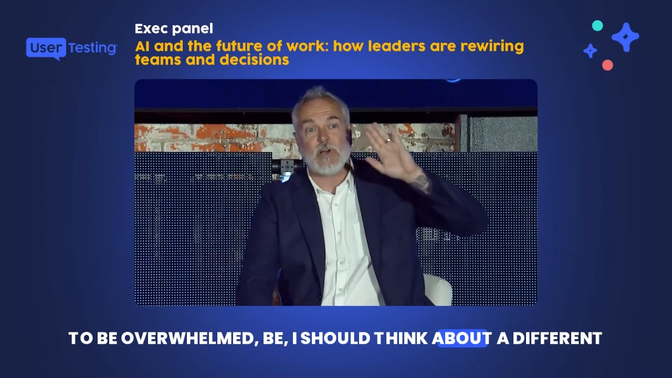
“If there was ever—we’ve been asking as researchers, as designers, for the seat at this table, for an opportunity to make some real impact into our companies. And I’m telling you, it is happening right now.”
Jason challenged the idea that AI diminishes the role of design and research. Instead, he described a once-in-a-generation opening.
Organizations are facing more decisions, faster timelines, and greater uncertainty. That creates a critical need for teams that can help leaders understand what matters, where risk exists, and how to move toward the right outcomes.
In that environment, design and research are not support functions. They are strategic disciplines.
But Jason also made clear that the role has to evolve. If a designer sees their job as only generating screens, or a researcher sees their job as only producing reports, AI will inevitably change that work. But if the job is to reduce uncertainty, guide decisions, and connect business strategy to real human needs, then the work becomes even more essential.
The opportunity is not to defend old workflows. It is to elevate the role of customer insight in a faster, more complex world.
The cure for AI anxiety is experimentation
A lot of AI anxiety comes from distance.
People hear predictions. They read headlines. They imagine worst-case scenarios. But they don’t always have direct experience using the tools, testing their limits, and understanding where they are genuinely useful.
Eliel Johnson sees a different pattern among people who immerse themselves in AI.
"If you get people who understand where the value is going to be, they can help shape how to adopt those tools to transform their jobs. They are less anxious because they're not thinking about this thing they've heard abstractly, but they're actually using it and seeing where it's good and not good and where it's powerful, not powerful."
The more people experiment with AI, the less abstract it becomes. They begin to see what it does well, where it breaks down, and where human expertise is still essential.
That firsthand experience replaces fear with discernment.
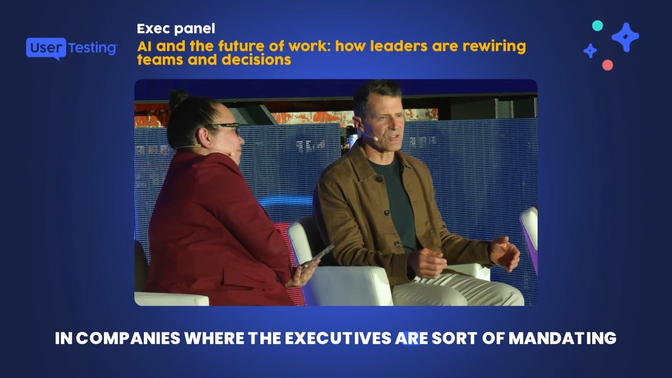
Eliel described how AI tools are helping people rediscover the energy of making. Founders are coding again. Executives are building again. Designers are experimenting with higher-fidelity outputs earlier in the process. Smaller teams can explore ideas that once required far more time and resources.
But experimentation is not the same as blindly adopting every new tool.
The real value comes when teams understand how to apply AI with the right context. That might include design systems, business rules, research insights, customer feedback, brand standards, data governance, or organizational knowledge. AI performs better when teams give it meaningful direction.
In other words, the fastest way to build confidence is not to read another prediction about the future of work. It is to start experimenting, learning, and sharing what works.
Curiosity may be the best response to AI uncertainty.
Customer insight keeps AI grounded in reality
Across the discussion, one point came through again and again: AI cannot replace the human signals that come from observing, listening to, and understanding real people.
Jessa made the point through a practical example. AI cannot give you an input signal more important than standing in a restaurant and watching an operator explain the workaround they have been using for eight months. That kind of insight comes from being close to the customer, the employee, the user, or the person experiencing the problem firsthand.
Eliel echoed the importance of customer stories. Data can inform decisions, but real voices and real experiences often move teams in ways that dashboards cannot. When executives hear directly from customers, the conversation changes. The problem becomes tangible. The stakes become clear.
That is where research and customer insight teams have a powerful advantage.
AI can summarize what already exists. It can identify patterns in data. It can accelerate synthesis. But organizations still need human teams to bring in fresh signals, interpret nuance, and ensure that decisions are grounded in lived experience.
Without that grounding, teams risk moving faster in the wrong direction.
With it, they can increase decision velocity—not just speed, but speed with direction.
The future belongs to teams that combine AI speed with human judgment
The conversation at Crafted was not about whether AI will change design, research, product development, or customer experience. It already has.
The real question is how teams will respond.
They can use AI to move faster through old processes. Or they can use it to rethink how decisions get made.
They can focus on what has been automated. Or they can focus on what becomes possible with the time they gain.
They can shrink back from uncertainty. Or they can step into the ambiguity and help their organizations find clarity.
The leaders who thrive in the AI era will be the ones who understand where technology can accelerate the work—and where human judgment must lead it.
That means asking better questions. Staying close to customers. Knowing when to slow down. Building confidence through experimentation. And never outsourcing accountability for the decisions that matter most.
ON-DEMAND WEBINAR