


Episode 223 | May 18, 2026
Design leadership in the age of AI: slowing down to think better
Explore design leadership in the age of AI—why slowing down, embracing creativity, and focusing on human insight leads to better product design.
Design leadership in the age of AI: slowing down to think better
The most dangerous idea in modern design may be that faster is better.
It’s a seductive belief, reinforced by every new tool promising acceleration, automation, and scale. In product teams, speed has become a kind of virtue signal: ship quickly, iterate often, move on. But as design leadership coach Andy Polaine argues, something essential is being lost in the rush—not just craft, but thinking itself.
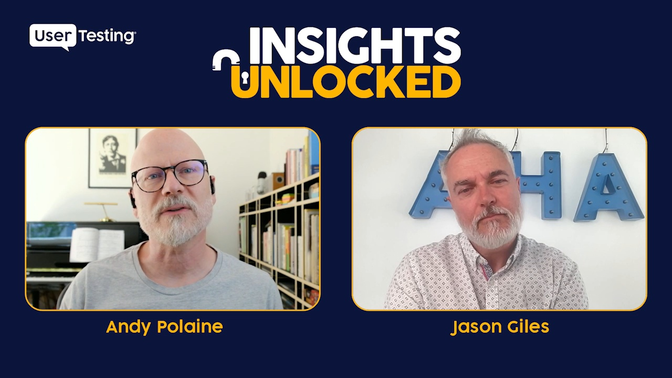
In a recent conversation on Insights Unlocked, Andy and host Jason Giles wrestle with a tension at the heart of contemporary design: how to reconcile the pressure for efficiency with the slower, messier processes that actually produce insight. Their conclusion is not anti-technology. It’s more unsettling than that. The problem isn’t the tools—it’s how eagerly we’ve handed over the thinking.
The myth of speed as progress
Speed, in digital product design, has become orthodoxy. Agile workflows, sprint cycles, and AI-powered tools all promise the same thing: more output, faster. The assumption is rarely questioned.
Andy does question it.
“We are trained… that you should spend every hour of your life being productive,” he said. The result is a culture where time spent exploring—without a clear deliverable—is treated as indulgent, even wasteful.
But creativity doesn’t behave like a factory line. It resists compression. It requires space.
What gets lost in the pursuit of speed is not just polish, but possibility. Under pressure, designers fall back on what they already know—familiar patterns, established systems, safe decisions. The result is work that is efficient, consistent, and increasingly indistinguishable.
Everything starts to look the same.
Andy describes this as the “age of average,” a kind of aerodynamic optimization of design where rough edges are smoothed away in favor of what performs predictably. Like cars shaped in a wind tunnel, products converge toward sameness—not because it’s better, but because it’s easier.
ON-DEMAND WEBINAR
Defensible Design: Making Confident Decisions at Speed
The lost art of “noodling”
There is a word Andy uses—half playfully, half seriously—that cuts against this trend: noodling.
By noodling, he doesn’t mean aimless distraction. He means deliberate exploration without immediate pressure to produce something useful. It’s the act of turning an idea over, testing its edges, letting it evolve.
“You discover all sorts of other things,” Andy explained. “When you have time to noodle about, you don’t have this idea that I have to be making something productive.”
In older creative workflows, this kind of exploration was built in. Designers sketched, iterated, discarded, and revisited. The process was visible, tactile, and often inefficient in the best sense of the word.
Today, the path from idea to output has collapsed. With AI tools, a half-formed thought can be instantly rendered into something polished. It feels like progress. But it can also be a shortcut that bypasses the most important part of the work.
“Going straight from a half-baked idea and prompting it,” Andy said, “and just taking whatever comes back… that’s the problem.”
The danger is not that the output is bad. It’s that it’s unexamined.
When tools start designing for us
Every tool leaves a fingerprint. Designers have always known this. The constraints and affordances of a medium shape what gets made.
But the influence of tools has grown more subtle—and more pervasive.
“There was a quote… ‘Adobe is the world’s art director,’” Andy recalled. Today, he suggested, the same might be said of AI systems. Their defaults, biases, and patterns quietly guide decisions, often without the user noticing.
This is particularly visible in the rise of generative design, where outputs can feel eerily similar across contexts. The term “slop” has emerged to describe this phenomenon: content that is technically competent but aesthetically hollow, marked by the signature of the tool rather than the intent of the creator.
It produces a strange reaction in users—something like an uncanny valley for design. It looks right, but feels off.
“We’re very sensitive to it,” Andy noted. “It just feels a little bit off.”
That sensitivity points to something deeper: a human instinct for authenticity, for the presence of intention behind the work. When that intention is missing—or obscured by automation—the experience becomes less meaningful, even if it is more efficient.
The design leadership dip
If tools are reshaping how design is practiced, they are also reshaping how designers see themselves.
Andy describes a phenomenon he calls the “design leadership dip”—a period of disorientation that occurs as designers move into leadership roles. Early in their careers, designers build identity through craft: the ability to make things, to produce artifacts that can be seen and judged.
Leadership requires a different skill set. It is less about making, more about guiding—less about output, more about people.
“At some point… you start doing less of that,” Andy explained. “And you’re starting managing and leading people. And that bit doesn’t get taught.”
The transition can feel like a loss. Confidence in craft diminishes, while competence in leadership is still developing. The result is a kind of professional limbo.
This shift is particularly acute in creative fields, where identity is closely tied to output. To stop making is, in some sense, to stop being.
But Andy argues that this is a narrow view of design. The real value of a designer is not tied to any specific tool or medium. It lies in the ability to think, to synthesize, to articulate.
“If you peg your career on a particular technology,” he said, “then yeah, it’s a real problem for you.”
Try MCP
Use UserTesting's MCP server to recruit participants, create studies, and launch tests from Claude, ChatGPT, Figma Make, and other AI clients.
What design leadership really requires
At its core, design leadership is not about tools or processes. It is about people.
This may sound obvious, but it is often overlooked. In design education and practice, the emphasis is still largely on craft—on producing work, not leading teams.
Yet the challenges leaders face are rarely technical. They are relational.
“I think all the stuff around design leadership… is people stuff,” Andy said. The most difficult problems are not about interfaces or systems, but about communication, alignment, and trust.
This is where the conversation returns to human-centered design—not as a methodology, but as a mindset. Understanding users is important. Understanding colleagues may be even more so.
In this sense, the skills required for effective design leadership are closer to those of a coach or therapist than a traditional designer. They involve listening, observing, and responding to subtle cues—tone of voice, body language, emotional undercurrents.
These are not skills that can be easily automated.
The illusion of productivity
The rise of AI has intensified the focus on productivity. Tasks that once took hours can now be completed in minutes. The promise is alluring: more time for strategic thinking, deeper work, creative exploration.
But that promise is not always fulfilled.
“There’s a lot of things that don’t have to be done,” Andy observed. Instead of using AI to rethink workflows, many teams use it to do the same work faster. The result is not transformation, but acceleration.
This creates a paradox. The more efficient the tools become, the more pressure there is to produce. Time saved is quickly reallocated to new tasks, new deliverables, new expectations.
The system absorbs the efficiency and demands more.
What gets squeezed out, once again, is the space for thinking.
Reclaiming depth in a fast-moving world
If there is a thread running through Andy’s perspective, it is a call to reclaim depth.
This does not mean rejecting technology or returning to slower processes for their own sake. It means being intentional about how tools are used—and what is valued.
It means recognizing that some parts of design cannot be rushed. That insight often emerges not from analysis, but from immersion. That understanding people requires time, attention, and presence.
Jason offered a telling example from his own work: watching a user testing session in real time, rather than relying on AI-generated summaries.
“There was a moment of feeling present,” he said. “Actually watching this person… hit me in a way that I realized… I’m going to need to be careful.”
The experience was not more efficient. It was more meaningful.
Andy sees this as a crucial distinction. Human connection—whether in research, collaboration, or leadership—is not easily replicated by machines.
“It’s like eating junk food,” he said. “I’ve eaten a lot of stuff, but I actually don’t feel nourished at all.”
The future of design is familiar
For all the disruption caused by AI and changing workflows, Andy’s vision of the future is surprisingly conservative.
“I think what it means to be a designer now is actually what it meant to be a designer about 20 years ago,” he said.
The fundamentals have not changed. Designers still need to understand people, imagine alternatives, and create solutions that improve the world in some way. The tools may be different, but the underlying work is the same.
If anything, the current moment offers an opportunity to return to those fundamentals—to move away from an overemphasis on output and toward a deeper engagement with process.
It is, in a sense, a reset.
Slowing down to move forward
There is a quiet radicalism in Andy’s argument. In a culture obsessed with speed, to advocate for slowness is to challenge the system itself.
But the goal is not slowness for its own sake. It is better thinking. Better work. Better outcomes.
The metaphor that lingers is not one of resistance, but of recalibration—like adjusting the focus on a lens. Move too quickly, and everything blurs. Slow down just enough, and the details come into view.
Design, at its best, is not about producing more. It is about seeing more clearly.
And that, as Andy suggests, requires time.
“You can’t do that if you are under pressure,” he said. “When you’re under pressure… you fall back on the stuff you’ve done before.”
Episode links
- Design confidence under pressure: Making decisions you can defend in the age of AI — A strong companion piece to Andy Polaine’s discussion about balancing speed, AI-assisted workflows, and thoughtful decision-making in design leadership.
- Effective AI: how to choose the right generative AI features—and build them fast — This guide explores how AI is reshaping UX, product design, and customer experiences, while emphasizing the importance of intentional, human-centered design practices.
- Designing with AI: outputs are easy—problems aren’t — This Insights Unlocked episode closely aligns with Andy’s themes around AI, creativity, design quality, and the risks of prioritizing speed over deeper thinking.
- UX research for AI: building trust in experiences — A thoughtful exploration of trust, human connection, and AI-assisted design that complements the episode’s conversation about maintaining meaningful human insight in product
- Andy Polaine's website
- Andy's book Service Design: From Insight to Implementation
- Andy on LinkedIn
- Andy’s newsletter
- Andy’s Power of Ten podcast
PLAYBOOK