


Episode 215 | March 23, 2026
How to turn customer insights into better products
Learn how product teams use customer insights, voice of the customer, and smarter prioritization to make better product decisions with Jeff Lash.
How to turn customer insights into better products
Product teams are drowning in feedback but still struggling to make better decisions.
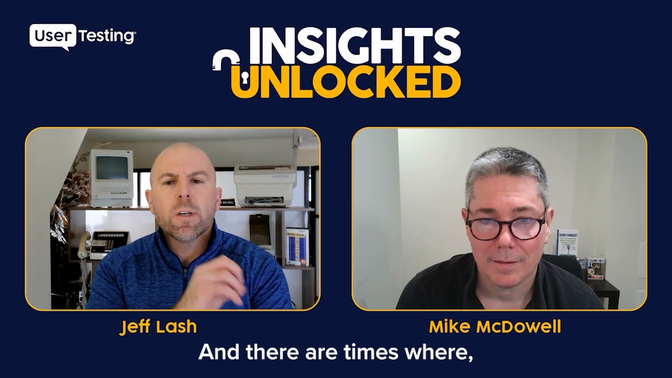
It’s a paradox that Jeff Lash, VP of Product Management at Insperity, has seen play out again and again. In a recent episode of Insights Unlocked, Jeff draws on decades of experience across UX, consulting, and product leadership to explain why more data doesn’t always lead to better outcomes—and what teams should do instead.
At the heart of the issue is a disconnect between collecting feedback and truly understanding it. That’s where product management customer insights become the difference between reactive teams and strategic ones.
The danger of taking customer feedback at face value
One of Jeff’s most memorable stories highlights a common mistake: assuming you understand what a customer means without digging deeper.
He recalls interviewing a nurse who said a product wasn’t “accessible.” At first, Jeff assumed she meant accessibility in the traditional UX sense—screen readers, font sizes, compliance. But that wasn’t it at all:
“Your product is only available at the nurse’s station… there’s only one computer… so it’s not accessible to me.”
The issue wasn’t usability—it was physical access.
This example underscores a critical point: customer feedback analysis requires interpretation, not just collection. Words like “accessible,” “intuitive,” or “easy” are often placeholders for deeper, more specific problems.
Jeff puts it simply: don’t assume—ask follow-up questions.
That mindset shift is foundational to strong voice of the customer in product management practices. Without it, teams risk solving the wrong problems.

ON-DEMAND WEBINAR
Continuous discovery in product development
Why asking better questions leads to better decisions
Many teams pride themselves on being customer-centric, but Jeff argues that listening isn’t enough. The real skill lies in how you listen.
“When someone says roadmap or persona or requirements… let me see it. Let me understand what it actually means.”
This applies just as much to customer conversations as it does to internal artifacts.
Strong product teams treat every piece of input—whether from customers, sales, or stakeholders—as a starting point for exploration. They probe deeper, clarify assumptions, and validate meaning before acting.
This approach transforms product decision-making process from reactive to intentional.
Think of it like diagnosing a problem: symptoms alone aren’t enough. You need to understand the underlying cause before prescribing a solution.
The imbalance between qualitative and quantitative insights
Modern product teams have no shortage of data. Analytics dashboards, A/B tests, and surveys provide a constant stream of quantitative signals.
But Jeff warns against over-relying on numbers alone.
“One insight from one customer can have… the light bulb can go off,” he said.
Quantitative data tells you what is happening. Qualitative research explains why.
This is where qualitative vs quantitative research becomes essential. The most effective teams combine both:
- Quantitative data to identify patterns and trends
- Qualitative insights to uncover motivations and context
Ignoring qualitative input is like reading a map without understanding the terrain. You might know where you’re going, but not what obstacles lie ahead.
For teams focused on customer-driven innovation, this balance is critical.
Not all feedback is created equal
Another common trap is treating all customer feedback as equally important.
In reality, context matters—a lot.
Jeff highlights two key filters:
- Target market alignment: Are these customers part of your ideal audience?
- Persona relevance: Which users or buyers are providing the feedback?
“We’re getting feedback… from customers that are not in our target market.”
Without these filters, teams can end up prioritizing requests that don’t align with their strategy.
This is where customer feedback prioritization becomes a strategic discipline, not just a tactical exercise.
It’s not about ignoring customers—it’s about focusing on the right ones.
Guide
How to enhance design efficiency through continuous user feedback
Escaping the “firefighting” trap
Many product teams spend their days reacting to incoming requests—sales asks, support tickets, stakeholder demands.
The result? A constant cycle of small fixes with little long-term impact.
Jeff describes this as a bottom-up approach to product development, “We’ve got a bunch of feedback… let’s just add them to the queue… and then it’s just this hamster wheel.”
To break out of this cycle, teams need a top-down perspective grounded in product management strategy.
That means aligning decisions with:
- Company vision and goals
- Product strategy and roadmap
- Defined priorities and outcomes
When teams evaluate feedback through this lens, they can make more intentional trade-offs—and avoid being pulled in every direction.

How voice of the customer becomes a “great equalizer”
One of the most powerful ideas Jeff shares is the role of customer insight in resolving internal conflicts.
Product teams often face competing opinions—from executives, sales, and other stakeholders. These disagreements can stall progress or lead to decisions based on hierarchy rather than evidence.
Jeff offers a different approach:
“Let the voice of customer be the great equalizer.”
Instead of arguing, bring real customer insights into the conversation.
This might include:
- User interviews
- Video clips of customer feedback
- Direct quotes or observations
By grounding discussions in actual user needs, teams can move beyond opinions and align around shared understanding.
This is a hallmark of effective customer-centric product development.
Roadmaps aren’t the problem—communication is
Roadmaps often get blamed for misalignment, but Jeff sees a different issue: how they’re presented.
“People take a roadmap that is designed for engineering and use that for other audiences.”
The problem isn’t the roadmap itself—it’s failing to tailor it to the audience.
Different stakeholders care about different things:
- Engineers: timelines, dependencies, technical details
- Executives: strategy, outcomes, business impact
- Customers: value, benefits, availability
When teams use a one-size-fits-all roadmap, confusion is inevitable.
Improving product roadmap best practices starts with understanding your audience and communicating accordingly.
When to trust feedback—and when to dig deeper
Conflicting feedback is inevitable. Sales might say one thing, while direct customer research says another.
Jeff’s advice? Don’t choose sides—investigate.
“You told me this client wanted X. Can I talk with them?,” he said.
By going straight to the source, teams can uncover the real need behind the request.
Often, the conflict isn’t as stark as it թվում—it’s just a difference in perspective or context.
This reinforces the importance of strong UX research in product management as a complement to secondhand insights.
The mindset that separates great product teams
Tools, processes, and frameworks all matter—but Jeff believes the biggest differentiator is mindset.
“The teams that are most successful have a growth mentality.”
Instead of dwelling on why something didn’t work, high-performing teams focus on what they can do next.
They:
- Embrace constraints as opportunities
- Continuously test and learn
- Accept that decisions are made with imperfect information
This mindset fuels faster learning and better outcomes over time.
It’s also what enables teams to evolve their data-driven vs insight-driven decisions into a more balanced, adaptive approach.
Building better products starts with better understanding
At its core, product management isn’t about features, roadmaps, or even technology—it’s about understanding people.
The teams that excel at customer insights don’t just collect feedback—they interpret it, challenge it, and use it to drive meaningful decisions.
They ask better questions. They balance data with context. They align around strategy. And they never stop learning.
Because in the end, the goal isn’t just to build products—it’s to build the right products.
And that starts with listening differently.
“The survey will tell you accessibility is a problem,” Mike recaps. “The interview will tell you what they mean when they say accessibility.”
Episode links
- Continuous discovery: transform your product development process–This on-demand webinar shows you how to integrate continuous customer feedback into product workflows to build better, insight-driven products faster.
- How to build customer-centric products without slowing down development–A practical guide to balancing speed and customer validation, helping teams make smarter product decisions without sacrificing agility.
- The future of customer insights at UserTesting in 2026–This podcast explores how teams can scale customer insights, leverage AI, and embed feedback into everyday decision-making.
- What are customer insights?–This blog post breaks down how to interpret customer behavior, uncover motivations, and use insights to drive better product and business outcomes
On-Demand Webinar: How UXR Leaders Can Shape the Role of Research in the Age of AI
Explore how leading UX Research teams are evolving from a service model to becoming strategic insight leaders.