


Episode 213 | March 09, 2026
Designing for frontline workers in a digital world
Designing for frontline workers: Andrew Ackermann from Samsara shares lessons on AI-powered tools, field research, and enterprise UX in physical operations.
Designing for frontline workers in a digital world
Most software is designed from behind a desk. But what happens when the people using it spend their days behind the wheel of a truck, under the hood of a diesel engine, or out in the field before sunrise?
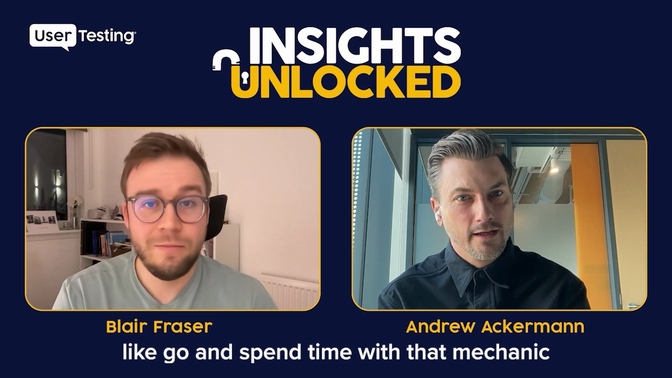
On a recent episode of Insights Unlocked, Andrew Ackermann, VP of Product Design at Samsara, pulled back the curtain on what it really takes when designing for frontline workers—the drivers, mechanics, and operators powering the physical economy. His perspective offers a sharp reminder that enterprise software isn’t just about dashboards and data. It’s about building tools that hold up in the real world.
After joining the conversation, Andrew made one thing clear: if you want to build meaningful technology for frontline teams, you have to leave the building.

Why designing for frontline workers requires humility
Andrew’s path into product design started with a moment of curiosity—watching designers transform text and type into something intentional and powerful. Years later, he experienced a similar awakening when he began working in physical operations.
“I had been kind of moving through this world for much of my life and never really asked myself the question, you know, whose job it is to deliver food,” he said. “What is the day in the life of a person that’s running a snowplow?”
That curiosity became foundational to his approach to designing for frontline workers. Unlike consumer apps that can be tested at scale from a distance, tools for physical operations require immersion. You have to see the environment. Feel the constraints. Watch the work unfold.
Andrew and his team regularly conduct ride-alongs, job shadows, and field visits. During one early experience, he spent a full shift with a truck driver in Arkansas. What he observed was revealing.
On-Demand Webinar: How UXR Leaders Can Shape the Role of Research in the Age of AI
Explore how leading UX Research teams are evolving from a service model to becoming strategic insight leaders.
The driver used Google Maps on his personal phone instead of his company’s commercial navigation software. When Andrew asked why, the answer was simple: “It’s just not very good.”
But even that wasn’t the whole story. When Google Maps suggested a turn, the driver ignored it. He knew the right truck entrance from experience.
“He’s actually like the software,” Andrew explained. “He’s creating this for himself. He’s piecing together sort of a broken user experience and going that last 5 to 10%.”
That last 5 to 10 percent is where thoughtful enterprise product design makes the difference.

Replacing paper is harder than it sounds
One of the biggest misconceptions in digital transformation is that replacing paper-based processes is easy. Andrew disagrees.
“Paper and pencil don’t break down,” he said. “There’s no outage for paper.”
If you’re building AI-powered tools for physical operations, you’re not just competing with other software vendors. You’re competing with clipboards, printed forms, whiteboards, and years of habit.
To win, digital tools must be undeniably better. That means layering intelligence on top of data. Making information searchable and actionable. Creating feedback loops that reduce friction over time.
It also means designing for real-world conditions. Gloves. Cold weather. Bright sunlight. Limited connectivity. Repetitive workflows performed multiple times a day.
These are the realities of frontline worker experience—and they often don’t show up in remote usability tests.
Elegance in gritty environments
Inside Samsara, Andrew and his team talk often about one word: elegance.
“It’s weird—we internally often use the term elegance,” he shared. “Have we created an elegant experience here?”
Elegance might sound out of place in conversations about fleet inspections or fleet management software, but Andrew uses it intentionally. For him, elegance is about flow. It’s about software that shows up at the right moment, delivers exactly what’s needed, and then gets out of the way.
“Sometimes the most elegant thing is for us to get out of the way,” he said.
In the context of mission-critical software, elegance isn’t decorative. It’s functional. When workers use a system 40 to 60 hours a week, even small inefficiencies compound. Every extra tap, every confusing alert, every workaround becomes friction.
Think of it like a well-balanced tool in a mechanic’s hand. If the weight is off by just a little, the strain builds over time. The same is true for digital tools in physical operations.
That’s why Andrew emphasizes deep field research and continuous iteration—core principles of human-centered design in enterprise environments.
From Google to physical operations
Before Samsara, Andrew worked at Google, where he helped design products used by millions. There, success could be defined by adoption at scale.
“If 5% of users in one day were using your feature, that would be considered a wild success,” he said.
In contrast, at Samsara, many customers rely on the platform as their operational backbone. This is operational technology (OpTech) that teams depend on to run fleets, manage maintenance, and ensure safety.
“You might need to use this thing ten times today,” Andrew explained. “Your whole job may depend on actually using this tool eight hours today to solve a wide variety of tasks.”
That shift—from occasional utility to daily operating system—reshapes design priorities. It demands durability, clarity, and relentless refinement.
It also reframes metrics. Revenue, renewals, and close-loss analysis provide direct feedback on whether the product truly delivers value. In subscription-based SaaS platforms, long-term customer retention becomes a proxy for product quality.
Research is everyone’s job
At Samsara, research isn’t siloed within UX. Andrew described a culture where sales engineers, support teams, designers, and executives all contribute insights from the field.
“We believe that research is something that everybody in the organization needs to be doing,” he said.
Trip notes from customer visits are shared widely. Patterns are identified collectively. Prototypes are tested early—sometimes beginning as simple verbal descriptions before evolving into Figma mockups or coded experiments.
This approach supports faster iteration across digital transformation in operations initiatives. It also reinforces humility.
“We know maybe a little bit more about technology or AI,” Andrew said. “But we’re also very humble and we don’t know what it’s like to run one of these companies.”
That humility builds trust—an essential ingredient when introducing new B2B UX design into established workflows.
The accelerating role of AI
AI is already reshaping how products are built. Andrew sees acceleration everywhere.
“We’re about to enter a world of just acceleration,” he said. “We’re able to do things quicker.”
Designers can prototype faster. Teams can synthesize research more efficiently. Startups can ship features at record speed. In the realm of AI in product development, the cost of experimentation is dropping rapidly.
But speed introduces a new challenge: signal versus noise.
“There’ll be a lot of static,” Andrew warned. “We can create things very quickly—but are they the right things?”
For teams building AI-powered tools for physical operations, the stakes are high. Features can’t just be flashy. They must reduce downtime, improve safety, or streamline workflows.
The real opportunity lies in blending AI capabilities with deep domain knowledge. As Andrew noted, frontline workers don’t leave their consumer expectations at the door. They expect intuitive, responsive experiences—even in enterprise environments.
This convergence of consumer-grade usability and enterprise-grade reliability is shaping the future of designing for frontline workers.
WEBINAR
Design Confidence Under Pressure: Making Decisions You Can Defend in the Age of AI
Scaling systems across hardware and software
Samsara operates at the intersection of hardware and software. Sensors collect data from vehicles and equipment. The platform surfaces insights. Design systems unify experiences across use cases.
Andrew described two types of designers within his organization: vertical designers focused on specific products like telematics, and horizontal designers responsible for systems such as reporting, workflows, and notifications.
This layered approach supports consistency across complex telematics platforms and reporting tools while allowing flexibility for specialized workflows.
It’s a reminder that strong design systems for SaaS platforms are more than visual libraries. They are operational enablers. They reduce cognitive load. They create coherence across features.
And when those systems are well-built, they make it easier to innovate without sacrificing usability.
Advice for product leaders and designers
For product leaders, UX researchers, and designers working in enterprise contexts, Andrew offered simple but powerful advice.
Be curious. Be humble. And ship.
“Talk to one. Maybe talk to five,” he said. “Start to notice some patterns, and then you have to start making.”
He cautioned against analysis paralysis. Field research is essential—but so is iteration. Real feedback emerges when tools are used in context, under pressure, in the flow of real work.
That mindset fuels progress in user research for industrial teams and supports continuous improvement in complex environments.
The physical economy may be invisible to many technology leaders, but it is vast, intricate, and essential. Designing for it requires stepping outside the conference room and into the field.
It requires building tools that are better than paper. Better than habit. Better than yesterday.
And above all, it requires empathy paired with execution.
As Andrew put it, “Just be really curious and be really humble.”
Episode links
The future of insight: how information workers leverage AI + human understanding to drive smarter decisions—This on-demand webinar explores combining human-centered research with AI to accelerate insights and decisions.
Complete guide to testing websites, apps, and prototypes—This guide covers planning and conducting user research to understand real user behaviors and expectations.
Creating new campfire moments: how the BBC designs for inclusivity—In this podcast episde, see how a discovery project with a core audience is inspiring the BBC to rekindle “campfire moments” in the digital age through inclusive design.
14 ways to leverage psychology in UX design—In this blog post, learn the basics of psychology in UX design. If you understand how the human mind works, it becomes easier to design experiences that capture attention and keep it.
On-Demand Webinar: How UXR Leaders Can Shape the Role of Research in the Age of AI
Explore how leading UX Research teams are evolving from a service model to becoming strategic insight leaders.