


Episode 233 | July 27, 2026
The mindset shift that turns UX research into a strategic business advantage
Paul Humphrey of Next shares his UX research strategy for scaling insights, earning stakeholder buy-in, and using AI in UX research responsibly.
The mindset shift that turns UX research into a strategic business advantage
What does "having a seat at the table" actually mean for a UX researcher?
On this episode of Insights Unlocked, Paul Humphrey, UX Research Lead at Next, shares his own, fairly grounded definition, and it has less to do with rank than you might expect.
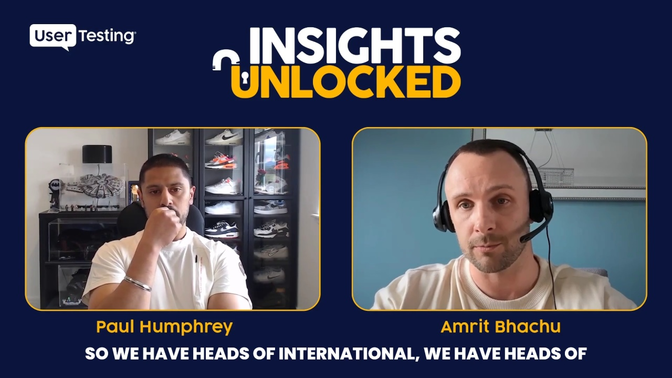
“I think a lot of people think that table is like, ‘I'm talking to the CEO, or I'm at board level’ ... For me, it's what's the most important table for me to do my job well, and that's to move the business forward,” Paul said. “At Next especially, that table for me is with the senior trade owners, with the heads of departments... Getting them bought into what you're doing is absolutely key, and the only way you can do that is by showing them the impact that the work you're doing is impacting their metrics.”
For years, UX researchers have chased influence by asking for bigger audiences, higher visibility, or a stronger voice in executive meetings. But Paul suggests that many teams may have been pursuing the wrong prize. Influence isn't measured by proximity to power. It's measured by whether your insights change decisions.
That's a subtle distinction, but an important one. And it reflects a broader shift happening across UX research, especially as roles change on who does the work.
The discipline is evolving from a service that delivers customer feedback into one that helps businesses make better decisions. The researchers making that transition aren't abandoning empathy or user-centered design. They're simply learning another language: the language of business.
REPORT
User Interviews’s State of User Research report
The business impact of UX research starts with better questions
Paul explained how his mindset changed over the course of his career.
Like many researchers, he entered the profession because he was fascinated by people. Curiosity drove the work. Understanding customers was the goal.
Eventually, though, he realized that curiosity alone wasn't enough.
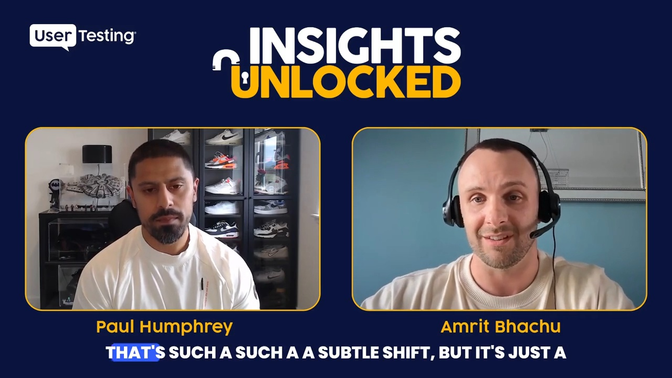
"I can do this job because I love it," Paul said. "But what's the need for it? What's your need? That's such a subtle shift. But it's just a single question."
That question—why?—changes everything.
Instead of simply responding to requests for user research, Paul encourages teams to understand what business problem they're actually trying to solve. Is the goal increasing conversion? Reducing customer service costs? Improving product adoption? Those answers shape better research and, just as importantly, make the results meaningful to those stakeholders seated around that table.
UX research strategy means speaking the language of the business
Research teams often wonder why executives don't seem excited by usability findings or participant quotes.
The answer isn't necessarily that leaders don't care about customer insights. It's that they spend their days managing revenue, operational efficiency, growth targets, and competing priorities. Customer insights only become valuable when they connect back to those goals.
Paul learned this by leaving his desk.
"I think you have to put yourself out there," he said. "Go grab coffee with them. Figure out what it is that they need... What are you working on? How can I help?"
Those informal conversations became the foundation of a much stronger UX research strategy.
Instead of waiting for requests, Paul invested time understanding the objectives of product owners and business leaders. That context allowed him to align user research with business metrics that already mattered across the organization.
When researchers understand what success looks like for their stakeholders, they stop presenting isolated findings and start delivering evidence that supports better product decision-making.
Scaling research doesn't always mean hiring more researchers
Many organizations assume scaling UX research requires dramatically expanding headcount.
Paul's experience suggests otherwise.
When he found himself as the sole researcher after colleagues left Next, he faced a familiar challenge: demand was growing, but capacity wasn't.
Rather than protecting research behind a gate, he opened it.
Designers were trained to conduct basic UserTesting studies on their own while Paul coached them through planning and analysis. Instead of acting as the only person capable of running research, he became an enabler of research across the organization.
The results were striking.
Testing adoption grew dramatically over consecutive years because research became part of everyday product development instead of a bottleneck waiting for specialist approval.
Perhaps more importantly, this shift gave Paul something researchers rarely have enough of: time.
Time to focus on strategic work.
Time to meet with business leaders.
Time to identify opportunities where customer insights could influence larger business outcomes.
The research function evolved from reactive too late in the process to being proactive.
Try MCP
Use UserTesting's MCP server to recruit participants, create studies, and launch tests from Claude, ChatGPT, Figma Make, and other AI clients.
Measuring UX research ROI requires owning your contribution
One of the hardest conversations in UX research centers on attribution.
Can research really claim credit for business results?
Paul's answer is refreshingly pragmatic.
Large initiatives involve countless contributors, making perfect attribution nearly impossible. But that doesn't mean researchers should disappear from the story.
He described one project focused on redesigning systems for a contact center. By continuously testing designs against business objectives like reducing training time and improving efficiency, the team helped produce measurable outcomes that included significant reductions in training and call handling times. It was an estimated £2.75 million in savings.
Researchers shouldn't be afraid to connect their work to outcomes, Paul argued.
"I think in bigger projects, go out there and attribute your value to that... Ensure that when you write your report... add in, 'By the way, this whole project made this amount of money, and we were part of it.'"
That mindset represents an important evolution in how organizations think about the ROI of UX research. And your stakeholders will let you know if your assumptions are off, which is a good thing because it means they are engaged in the project.
Customer insights don't exist in isolation. They influence product decisions, reduce risk, improve customer experience, and create measurable business value. Researchers shouldn't shy away from explaining that connection.
AI won't replace curiosity, but it will amplify it
No discussion about the future of UX research (nor episode of Insights Unlocked) feels complete without talking about AI.
Paul approaches the technology with equal parts enthusiasm and caution.
At Next, researchers are actively experimenting with AI to accelerate workflows, summarize findings, and improve efficiency across a growing international business. But speed alone isn't the goal.
Accuracy still matters.
Validation still matters.
The human researcher still matters.

"I think the expectation of speed and accuracy is going to just go through the roof," Paul said.
Rather than replacing researchers, AI changes where researchers spend their time.
Think of it less like an autopilot and more like a power steering system. It reduces the effort required for routine work while leaving the driver responsible for navigating the road.
Paul also warned about emerging risks like AI-generated misinformation (AI poisoning) and the importance of validating sources before trusting AI-generated outputs. For UX research, where credibility depends on trustworthy insights, that validation layer becomes just as important as the technology itself.
Organizations chasing faster research without preserving quality may discover they're simply producing faster mistakes.
ON-DEMAND WEBINAR
How UXR Leaders can shape the role of research in the age of AI
The future belongs to strategic UX research
Perhaps the biggest takeaway from the conversation isn't about AI or research operations.
It's about identity.
UX researchers have often been positioned as people who collect customer feedback.
The next generation of UX research leaders will be known for something different.
They'll be recognized as partners in product strategy.
They'll understand customer insights and business metrics with equal fluency.
They'll know when to ask about usability and when to ask about organizational goals.
Most importantly, they'll recognize that influence isn't granted through organizational charts. It's earned by consistently helping teams make better decisions.
Paul didn't achieve greater influence by demanding a bigger seat. He simply made himself indispensable to the conversations that mattered most.
That lesson extends well beyond UX research. The most valuable expertise isn't the knowledge you possess. It's your ability to connect that knowledge to outcomes other people care about.
As Paul put it, the mindset researchers need most isn't mastery of a particular tool or framework.
"I think that's the key thing," he said. "Be open to change. Go and try some stuff with it... What's the pain point you've had for a long, long time that you've never been able to do anything with that this technology is probably going to open you up to? ... I think the researchers who jump on and really are adaptable... are probably going to be the ones who will take research into the next stage."
Episode resources
- Paul Humphrey on LinkedIn
- Next website
- Amrit Bhachu on LinkedIn
- Nathan Isaacs on LinkedIn
- Website: Connecting to value: Tips, tools, and tactics to help demonstrate the ROI of research and insights. This on-demand webinar closely aligns with Paul's discussion of tying UX research to business outcomes. It covers how to align research with business objectives, connect projects to measurable metrics, and effectively communicate the value of research to stakeholders.
- Guide: The executive's guide to empathy-driven ROI: A practical guide for demonstrating the business value of customer insights and experience research to executive stakeholders. It complements Paul's emphasis on speaking the language of the business and proving the ROI of UX research.
- Podcast: Calculating and communicating the ROI of UX research in your organization. Dave Kerry discusses how UX research drives business growth, reduces operational costs, accelerates innovation, and mitigates risk—many of the same themes Paul explores through his experience at Next, including connecting research directly to business metrics.
- Blog: AI might finally deliver on the democratisation of UX research—but only with researchers at the centre. This post echoes Paul's perspective on empowering designers to conduct tactical research while allowing researchers to focus on strategic work. It also examines how AI can help scale research without diminishing the critical role of researchers in maintaining quality and governance.
The Total Economic Impact™