


Negative customer reviews: an underutilized and powerful CX tool

It probably seems obvious that great customer reviews can boost sales and reflect positively on your brand, and that bad reviews can hurt them. But have you ever considered how these reviews play a role in your overall customer experience?
Understanding how your customers (and potential customers) interact with your brand, and more broadly, your customer experience can have a tremendous impact on your success. In fact, customer experience has become so important—sometimes even more important than products themselves—that more than 80% of consumers are willing to pay more for a great one, according to research by Capgemini.
Now, more than ever, there’s an emphasis on CX and a demand for new and improved experiences with every interaction or purchase. This can be daunting for sure. Worse though, is the damage wrought by negative CX, especially in the form of customer reviews. Whether by word-of-mouth, social media, or on a product page one negative review can send a ripple effect that can’t be ignored.
The power of customer opinion
No business should ever underestimate the power of customer reviews. Good or bad, they help potential customers form educated opinions about a product or experience. They help build trust through authenticity. And by collecting reviews across your product pages you make them transparent and easy to find.
The benefit of positive reviews is clear. However, negative reviews can sometimes outweigh the positive, because consumers pay special attention to them. Consumers look at negative reviews for a multitude of reasons:
- Understand the downside(s) of a product or experience they’re researching as seen by their peers
- Learn why consumers with negative experiences had that type of experience
- Weigh reviewer feedback alongside the business’ description of a product or experience
- Balance out large numbers of overly positive reviews to validate the authenticity
But before you close up shop and worry too much about your negative reviews, keep in mind that bad reviews don’t always mean bad business. Just recently, I was shopping for new luggage that would be suitable for checking. I knew I wanted a hard case because my fabric luggage was dirtied in just a few trips, so I was recommended to check out the AmazonBasics Hardside Spinner.

Despite the fact that each of these listings has 10k+ reviews and a 4.5-star rating, when I read the comments, the “most helpful” ones (determined by vote) were mostly negative. From complaints about the material quality to the wheels to the handles, I was immediately second-guessing the purchase that I was excited to make.
But then I noticed that the majority of negative reviews weren’t very credible. Here’s an example:
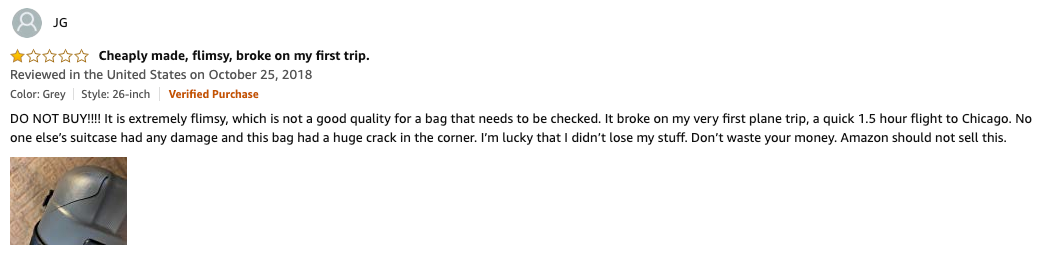
When reading reviews, I have to feel as though I can trust the reviewer. How could this person possibly know that no one else received a damaged suitcase? Why did they try to attack Amazon’s brand? As someone who has several AmazonBasics products, I trust Amazon as a brand and its products. Because I couldn’t relate to the reviewer, I decided to ignore that review (and many others like it).
Long story short, I was right to side with the majority. My bag survived the test of travel with flying colors (no pun intended). Besides, I probably would have been more skeptical if Amazon managed to attain a perfect 5-star review anyways.
How to be proactive about negative customer reviews
Despite the scenario I just detailed, negative reviews still aren’t ideal and shouldn’t be ignored. If we think about reviews as customer feedback, they can be one of the most valuable assets for businesses of all types and sizes. While negative reviews are an extremely visible part of your brand that’s nearly out of your control, you can still use them to your advantage.
Negative reviews can help you:
- Improve search visibility
- Measure and optimize the customer experience
- Inspire consumer trust
While it’s impossible to eliminate negative customer reviews altogether, here are some simple strategies for making them work to your advantage.
1. Leverage customer reviews to focus your usability testing
One way you can make your customer reviews work for you is by taking the comments and concerns and testing them. If we go back to my suitcase example, in one review, someone mentioned that the suitcase arrived with the TSA locks already locked and without instructions for resetting.
By employing remote usability testing, Amazon could test the unboxing and lock features of their product. Remote usability testing is essentially a method of research that uses an insight platform to record the screen and voice of test participants as they interact with a product or experience in their natural environment. The benefit of this type of test is that Amazon could theoretically test the unboxing of their product in the home of their users.
2. Empathize with and learn from the reviewer
Customer reviews offer unique insights for brands into the customer experience, which helps bridge the experience gap. Essentially, they have the power to provide critical information about what customers think about a brand and aspects of the buying journey.
As customer experiences have become more digital, the interactions have become less human. However, reviews can be foundational to understanding your customers’ wants and needs so you can better empathize with them when you’re making decisions for improving your products or experiences. Regular evaluations of reviews help companies recognize changes in sentiment and use those emotions to inform improvements to the customer experience.
3. Refine and tailor brand messaging
Customer reviews can also help companies refine their brand messaging and tailor it to match what matters most to customers. If the reviews show that customers respond well to certain aspects of a brand, product, or experience, those preferences should be used in marketing to new customers. Speaking the customers’ language builds trust and connection.
Customers are more connected than ever before
Think about the last time you purchased a product or experience. I bet you took the time to read the reviews and used them to weigh your options. And that’s natural. Customers want to share experiences, and they value what their peers have to say.
Customer reviews provide valuable insights that can help refine the overall customer experience to better align with customers’ thoughts and expectations. By seeing the world through your customers’ eyes—both the negative and positive—you can create experiences for them that are more human.
Customer reviews are inevitable, so it’s your job to use them to your advantage. By using them as a powerful tool for improving CX, negative reviews won’t seem so negative.
On-Demand Webinar: How UXR Leaders Can Shape the Role of Research in the Age of AI
Explore how leading UX Research teams are evolving from a service model to becoming strategic insight leaders.