


Design research is glue: why the best researchers don't just report, they connect

Every researcher has felt it: the quiet, sinking realization that a meticulously built report has landed in an inbox, been skimmed once, and quietly died there. Brad Carrera, Senior Manager Design Research at McDonald's, has felt it too. He just refuses to accept it as the cost of doing business.
Speaking recently at a UserTesting conference, Brad argued that the discipline of design research is at an inflection point—not because of artificial intelligence, but almost in spite of it. "It can't be replaced by a large language model," he said of the work that actually moves organizations. Reports can be automated. Understanding cannot.
When research becomes a transaction
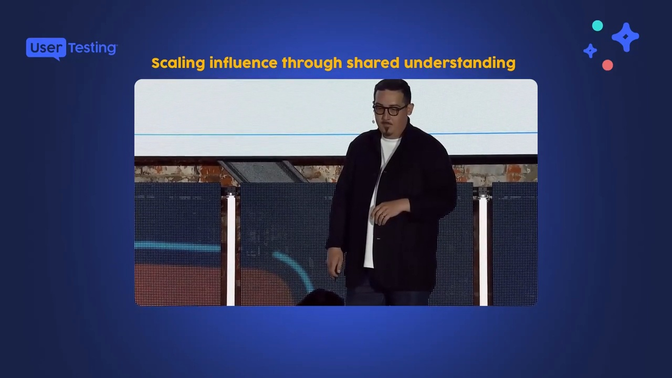
Brad's story begins with a familiar shape: one researcher, one intake form, one report at a time. Requests came in. Findings went out. It looked, on paper, like research was happening. But something was missing.
"Getting a report is not the same as experiencing your customers," he said, describing years of usability studies that were technically sound and organizationally invisible. Stakeholders read bullet points about a button that should move. They never felt the tension of a parent ordering a Happy Meal with three kids screaming in the backseat. The insight was factual. It just wasn't felt.
And feeling, Brad insists, is the whole point.
INSIGHTS+
Learn the real secret to scaling influence at work
The case for glue
This is where Brad's central metaphor arrives, and it is a good one. Researchers, he argued, are not meant to be gatekeepers of knowledge, dispensing findings from behind a closed lab door. They are meant to be glue—the connective tissue between marketing, product, design, and franchise leadership, groups that, inside a company as vast as McDonald's, rarely speak to one another at all.
"Influence by authority is not influence," Brad said. "That's compliance." And compliance, he noted dryly, tends to breed resentment rather than belief.
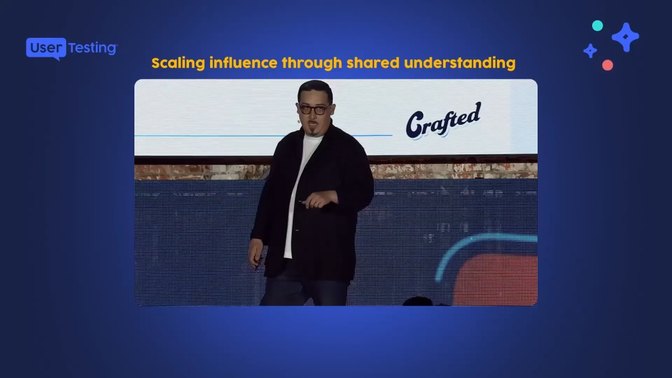
The alternative is slower and messier. It means dragging a product director, a head of design, and a tech lead out of their offices and into a car with an actual customer. It means building what Brad calls a web: a loose, expanding network of stakeholders who no longer need research translated for them, because they watched it happen.
He describes the early version of this work with disarming honesty, comparing it to a piece of found art he once saw online—"random crap glued to a board." The relationships felt arbitrary at first. Over time, though, the picture resolved into something closer to a finished puzzle, each stakeholder a piece that made the whole thing hold water.

Try MCP
Use UserTesting's MCP server to recruit participants, create studies, and launch tests from Claude, ChatGPT, Figma Make, and other AI clients.
From bottleneck to belief
As demand for this kind of research grew, Brad's team faced a second problem entirely: they had made themselves indispensable, and indispensable is another word for bottleneck. So they shifted again, from doing research for teams to building research capability within them—training designers and product managers to run their own usability sessions, with researchers stepping back from execution and toward strategy.
This is the quieter, more radical part of Brad's argument. Scaling research influence does not mean growing a research team's headcount, though his did, from one person to twelve. It means giving away the work that anyone can learn, so that the irreplaceable work—the relationship-building, the context-gathering, the glue—gets the attention it deserves.
"You're definitely more than the number of decks that you create," Brad said, a line that landed as both a rebuke and a relief.
The real product
McDonald's, Brad reminded the room, does not sell an app or a kiosk. It sells five minutes of predictability in someone's chaotic day. That distinction—between the artifact a team ships and the experience a customer lives—is the quiet thesis running underneath everything he said.
Shared understanding, not shared documentation, is what actually changes how organizations behave. Brad's closing challenge was less a call to action than a reframing of the job description itself.
"You are the glue," he said, "that can bring your people together, rally around your customer, rally around your users."
Additional links and resources
- Turbocharge your research practice with ResearchOps—Kate Towsey, research operations manager at Atlassian, shares what it took to build a global ResearchOps team and how operations work amplifies research's reach and impact across an organization, echoing Brad's shift from a lone researcher to a scaled, embedded team.
- An essential guide to research operations—A deep dive into the five components of a ResearchOps program, including knowledge management and stakeholder communication, directly paralleling Brad's move from a "transactional" research model to one built on infrastructure, shared knowledge hubs, and cross-team trust.
- AI in UX research: customer trends and impact—Featured on UserTesting's Insights Unlocked podcast, this episode discusses how researchers are expected to move beyond handing over reports to instead curate experiences that build empathy and influence decisions—a close echo of Brad's "glue work" philosophy.
- How to get stakeholder buy-in for user research: expert tips—Practical tactics for pulling stakeholders into the research process itself—through observation, storytelling, and shared experience—rather than simply handing them a report, mirroring Brad's belief that "getting a report is not the same as experiencing your customers."