


The $25 billion bet: what real drivers told us before you launch your next infotainment system
Right now, some of the biggest names in the vehicle industry are making a defining bet on their infotainment systems.
GM is phasing out Android Auto in favor of its own Gemini-powered system. Rivian and Tesla never offered phone mirroring in the first place, betting that deep, native AI integration beats it outright.
The upside case is real: tighter control of the driving experience, richer vehicle data, and—as GM has been candid about—new subscription revenue that phone mirroring never let manufacturers capture. Analysts have floated numbers as high as $25 billion a year in potential subscription revenue by 2030.
It's a bold strategy. It might be the right one. But it's also the kind of bet that's very hard to unwind once you've shipped it—and right now, most of the evidence behind it is coming from press releases and boardroom projections, not from drivers.
So we asked them.
What we did
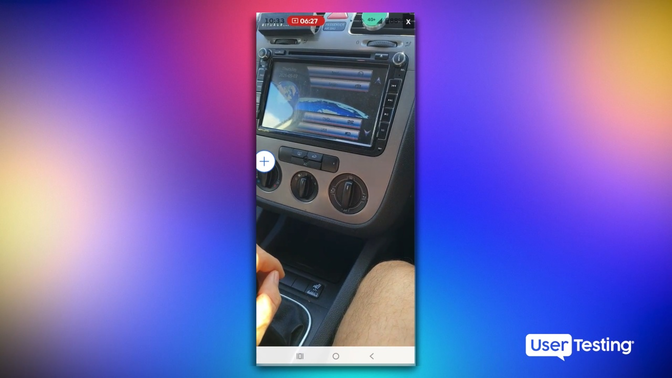
We ran a short, unmoderated test with real drivers, in their own cars, using their own infotainment systems—no lab, no script beyond a few guided tasks: first impressions, connecting Bluetooth, starting navigation, adjusting the climate, and reflecting on what they'd change. They filmed themselves on their phones and talked out loud the whole way through. Turnaround: days, not months.
GUIDE
Testing mobile experiences
The goal wasn't to grade any single system. It was to see, in drivers' own environments and own words, where the friction actually lives—and what they reach for when the native system doesn't deliver.
Where it actually breaks down
The home screen, almost everywhere, was the easy part. Drivers described it as clean and straightforward—one even put their car's layout on par with a Tesla for simplicity. That's worth pausing on, because it means the story here isn't "infotainment is bad." It's more specific, and more useful, than that: drivers can tell exactly where a system is doing fine and where it isn't, and they'll say so unprompted.
Bluetooth is where things started to slip. More than one driver got lost hunting for the pairing screen, working through menu labels like "telephone settings" and "manage mobile devices" before landing somewhere that actually let them connect a phone.
Voice search for navigation failed outright in one session, forcing a manual workaround before the car even moved.
And climate control, on more than one system, wasn't a screen task at all—drivers reached straight for a physical knob, in some cases estimating the exact temperature by feel rather than reading it off a display. One driver, in a car barely a few years old, said the whole thing already felt dated.
None of this is a fluke of a small sample. It lines up with what the industry already knows in aggregate—JD Power's APEAL research has consistently found higher owner satisfaction with Android Auto and CarPlay than with native infotainment systems. What that survey data doesn't tell you is why.
Watching real drivers try to do real things does: a menu path that doesn't match how someone actually thinks about "connect my phone;" a voice search that just doesn't work; a screen task that never had a chance against a knob that's been there the whole time.
The workaround isn't perfect either—which is the more useful finding
It would be easy to tell this story as "native systems bad, CarPlay good," but that's not quite what showed up on camera. Several drivers said they lean on CarPlay simply because it's familiar and saves them from re-learning a new screen—but they also described real friction getting there: multiple taps to load, occasional drops even with Bluetooth already connected, and in one case, wireless CarPlay sitting grayed out on the screen, cable required, with no clear explanation why.
That's a more useful finding for anyone building the next system than a simple "give them CarPlay" verdict. Drivers aren't loyal to phone mirroring. They're loyal to whatever gets them connected and moving with the least friction—and right now, that's phone mirroring by a narrow margin, not because it's flawless, but because the native alternative hasn't cleared an even lower bar.
This is precisely the kind of thing that's cheap to find out now but expensive to fix later
Nothing our drivers described was a demand to rebuild the system from scratch:
- A back button that shows up consistently, not just in some menus.
- Wireless CarPlay that isn't quietly disabled.
- A voice search that works, or gracefully hands off to typing instead of failing silently.
- A bit more color and personality on a screen one driver described as having "no fun going on."
These are the kind of specifics that are easy to miss in a satisfaction score and impossible to miss the moment you watch someone actually try to use the thing. That's the real value of this kind of testing—not instead of the big survey data, but alongside it, translating "we scored lower than CarPlay" into the exact three or four moments where a real person got stuck, said so out loud, and told you what would have made it easier.
The takeaway for manufacturers making this move
Pulling back from CarPlay and Android Auto isn't inherently the wrong call—plenty of good arguments support it, from data ownership to genuinely richer AI integration. But the drivers we spoke to made one thing clear: they didn't choose phone mirroring because they love Apple or Google. They chose it because, on balance, it worked better than what was already in the car—even with its own rough edges. Replace it with something that doesn't clear that same bar, and you haven't upgraded the experience—you've just changed what drivers are frustrated with.
The teams who get this right will be the ones who keep finding out, from real drivers in real cars, exactly what "better than phone mirroring" needs to feel like—before launch, and at every update after it.
That's a test that takes days, not quarters. And the sooner you run it, the cheaper the answer is.
Additional resources
Webinar: Moderated vs. unmoderated research: choosing the right method—Breaks down when to use unmoderated testing (like the in-car, self-filmed sessions in this post) versus moderated approaches.
Guide: Testing mobile experiences—covers how to gather real-world, in-context feedback on connected devices, directly relevant to testing infotainment touch points like Bluetooth pairing and voice search.
Podcast episode: Designing for frontline workers in a digital world—Samsara's VP of Product Design, Andrew Ackermann, discusses designing hardware-software experiences for people behind the wheel, closely paralleling the driver-facing UX challenges in this post.
Blog post: Automotive UX/UI: improving user experience—covers UX and UI considerations specific to vehicle technology, including infotainment and connectivity features.
See a demo
Curious what your own customers would say about your infotainment system, before or after a launch decision like this? That's exactly the kind of question fast, real-world testing is built to answer.