


The confidence gap nobody wants to talk about

The confidence gap nobody wants to talk about
A designer today can ship in an afternoon what once took a hundred people a year to build. That should feel like triumph. Instead, according to new research from UserTesting, it feels a little like vertigo.
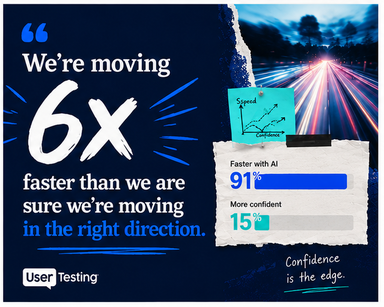
The AI has made design faster. But is it more defensible? report on design defensibility surveyed 183 designers across the US, UK, France, and Germany, and the headline number is almost bracing in its simplicity: 91% say their work moves faster in AI-enabled environments. Only 15% feel more confident in the quality of that work.
Bobby Meixner, who presented the findings on a recent UserTesting webinar, called it "a six-to-one gap between how fast we're moving and how sure we feel about where we're actually going."
That gap is the story. Not the tools. Not the acceleration. The gap.
Speed was never the hard part
Every technology that eventually became invisible to us was, at some point, an act of persuasion. Bobby opened his talk not with a chart but with a scene: North London, 1967, a sitcom actor named Reg Varney in a cardigan and a golf hat, sliding a mildly radioactive paper voucher into a wall and walking away with ten pounds. The first ATM. No teller, no signature, no card—just a wall that was supposed to be trusted.
"Somebody had to sit in a room full of most likely conservative bankers," Bobby said, "and say, people are going to walk up to a wall and put a radioactive piece of paper into a slot and trust that it's going to give them their money."
ON-DEMAND WEBINAR
Designing with Confidence at Scale: how AI is changing the way UX teams generate and share insight
That, more than the engineering, was the actual achievement. The technology was ready long before the room was.
Design work has always carried two separate jobs bundled into one title: building the thing, and making the case for the thing. AI has become extraordinarily good at the first job. It has done almost nothing for the second. And so the gap between speed and confidence isn't really a technology problem. It's a leftover problem—the residue of a skill nobody automated because nobody thought to.
Where confidence actually breaks
The report's most useful detail isn't the topline stat. It's where, specifically, confidence starts to erode. In early-stage work—brainstorming, first drafts, synthesizing rough research—designers rate their confidence at a respectable 4.1 out of 5. AI is, by every account, a superb collaborator at this stage. It solves what Bobby called "that blank page problem."
But confidence drops to 3.6, then 3.7, as decisions move closer to something irreversible: the design ships, the money moves, a real user's hands are on the thing. Bobby framed this as "the reversibility factor"—confidence holds when a decision is cheap to undo, and it declines exactly as undoing gets harder.
Compare that to hailing a stranger's car off an app, a decision an entire generation once considered obviously reckless. "That's pretty irreversible," Bobby said dryly. "Somebody had to be really, really sure."
Nobody, notably, has to be that sure anymore. Sixty-five percent of designers surveyed can't confidently say AI has made their outcomes better. Some say results are simply unchanged; a smaller share say they're worse. Meanwhile, accountability for those outcomes is scattering across the org chart—spread thin enough that, as Bobby put it, "in 1967, exactly one person's name was on the ATM in London. Today, nobody's necessarily sure whose name is on the decision."
REPORT
Defensible design in the age of AI
AI is speeding up design—but not confidence. Learn how 183 designers navigate risk, validation, and accountability in 2026’s AI-driven workflows.
The part AI still can't do
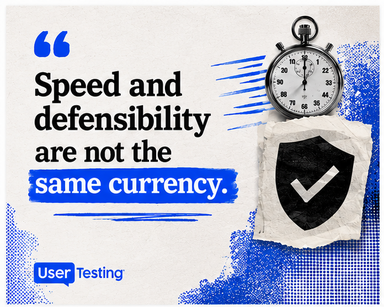
If there's a thesis buried in all this, it's that speed and defensibility are not the same currency, and treating them as interchangeable is where teams get into trouble. You can move fast and still be unable to explain, convincingly, why you moved that direction at all.
Bobby's closing example made the point better than any statistic could. Every "historical" photograph in his own slide deck—the ATM, the early iPhone, the first rideshare pickup—had been generated by AI. Each looked plausible. Each had something quietly, almost imperceptibly wrong with it. And in every case, a human noticed.
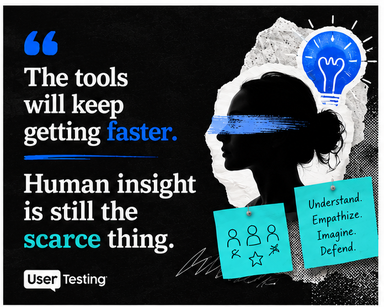
"Human insight is still the scarce thing," Bobby said, "and it's still what makes everyone valuable in an AI-driven world."
The tools will keep getting faster. That part isn't in question. What remains, stubbornly, is the older job—the one that predates any of this technology and will very likely outlast it: understanding people well enough to imagine what they don't yet know they need, and defending that vision, patiently, until it exists.
Additional resources
- Defensible design: making confident decisions at speed — Andrew Hogan (Figma) and Logan Morris (CarMax) discuss how teams can pair fast AI-driven iteration with the evidence needed to stand behind a decision, echoing the exact speed-versus-certainty tension Bobby raised in the webinar.
- Complete guide to testing websites, apps, and prototypes — a practical primer on moderated and unmoderated usability testing, directly supporting the "validate before you ship" point Bobby made in the Figma Make demo.
- Designing with AI: outputs are easy, problems aren't — Louis Rosenfeld and Llewyn Paine unpack why AI-generated design work can "sound right but be hard to verify," a near word-for-word extension of the confidence-gap data Bobby presented.
- How to make confident design decisions at AI speed — a practical checklist built from a UserTesting/Figma/CarMax panel, distilling the same "more output, less certainty" problem into actionable steps for design teams.

Try MCP
Use UserTesting's MCP server to recruit participants, create studies, and launch tests from Claude, ChatGPT, Figma Make, and other AI clients.