

How University of Washington Master’s students used human insight to improve the customer support experience

A capstone project is an important project that represents the culmination of years of students’ study and research, giving them the opportunity to showcase their knowledge and skill by applying what they’ve learned to solve real-world problems.
The students in the Master's program for Human Centered Design and Engineering at the University of Washington (UofW) partnered with UserTesting and a Fortune 500 software company to tackle a familiar, real-world challenge of improving a company’s self-service support experience.
Considering how much business is conducted digitally, it’s crucial that customers can get what they need, quickly and easily, from a company’s website—especially when they need help or customer support. According to Nielsen Norman Group (NNG), contacting a company’s customer support team, “often reflects a UX failure…” NNG also suggests that direct contact with a company’s customer support team indicates that customers weren’t able to get their needs met easily through a company’s website, causing frustration for the customer, and added resources needed for the company to be available to help those customers—or risk losing that business.
The UofW team felt confident that they could improve the self-service support experience for the software company which would not only create a better customer experience, it would also reduce the strain on live support teams, freeing them up to tend to more complicated problem solving with customers.
We followed up with the four students who completed this project to learn more about their project—and their first experience with UserTesting and how it impacted their approach to creating a better experience for users.
The challenge
A common challenge with customer support teams is balancing the level of interaction between live support and self-service. While some situations will require more hands-on, in-person support, many challenges users face are often easily resolved by users themselves, with a bit of guidance.
This is where self-service support comes into play and was exactly what the UofW team and their sponsor were hoping to improve. The team wanted to elevate the self-service support experience so that users could more easily get the answers they needed quickly and easily, which would reduce the demand for live support and free up support representatives for more complicated support.
The solution
To get the best of both worlds, the team opted for a mix of moderated and unmoderated testing. First, they got to know real users, face-to-face by conducting moderated customer interviews. By speaking directly to customers of varying backgrounds and demographics, the team got a great sense of how their planned updates to the support page would meet the needs of a variety of users.
Taking the insight they gained through the user interviews, the team iterated and improved on their design and moved forward with conducting remote testing with a larger sample of users around the world to gather both qualitative and quantitative data on the usability of the design updates.
Overall, the team conducted three different rounds of testing and iterated upon the designs following each round.
The verdict
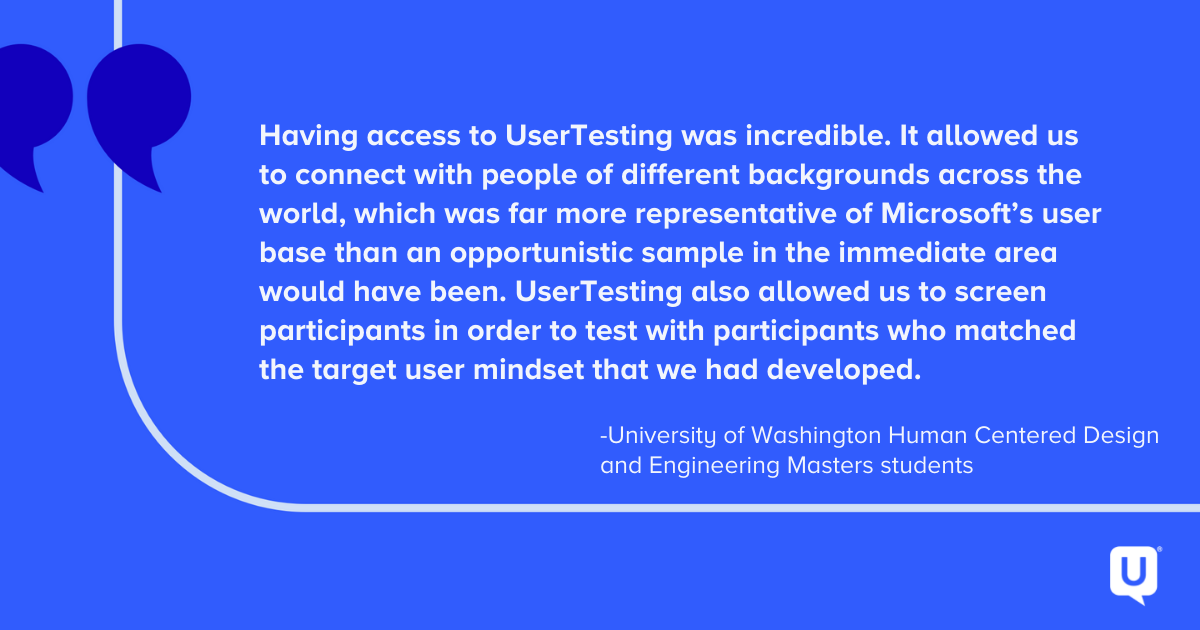
Since this was the first exposure the students had to the UserTesting platform, we were eager to hear what they thought about the experience. Here’s what the students had to say.
About the UserTesting Education Partner Program
The UserTesting Education Partner Program provides instructors of qualified programs with free resources to incorporate customer-centric best practices and hands-on learning into their curriculums for design, data science and AI, UX, business, and marketing. Learn more and apply here.