


Episode 225 | June 01, 2026
Designing trustworthy AI with the Sense, Shape, Steer framework
Learn how Bansi Mehta’s Sense, Shape, Steer framework helps teams design trustworthy, human-centered AI experiences users adopt.
Designing trustworthy AI with the Sense, Shape, Steer framework
The AI gold rush has produced an astonishing number of products that nobody entirely trusts.
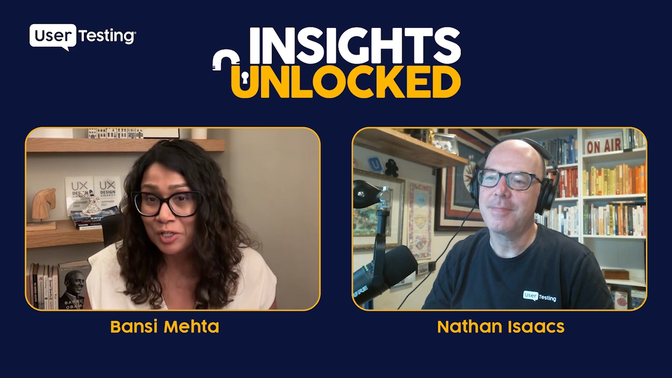
That tension sits at the center of a recent conversation on Insights Unlocked with Bansi Mehta, founder and CEO of Koru UX, whose work designing complex enterprise and healthcare systems has given her a front-row seat to the messy reality of AI product design. While many companies are sprinting to add copilots, agents, and generative interfaces to nearly every workflow imaginable, Bansi argues that most organizations are still asking the wrong question.
Not “What can AI do?”
But rather: “What problem are we actually solving for humans?”
It sounds obvious. Yet somewhere between investor pressure, boardroom anxiety, and the collective fear of being left behind, many teams have abandoned the fundamentals of human-centered AI design. The result is a strange digital landscape filled with features that demo beautifully, impress executives for approximately seven minutes, and quietly frustrate the people expected to use them every day.
“We have a solution,” Bansi said during the interview, “now let’s find a problem for it.”
It may be the most accurate summary of the current AI boom.
ON-DEMAND WEBINAR
Leveraging AI in UX design
The dangerous seduction of AI-first thinking
There is a particular kind of panic spreading through enterprise organizations right now. Product teams feel it. UX leaders feel it. Executives definitely feel it.
Every company fears becoming the next cautionary tale — the incumbent that moved too slowly while competitors embraced AI transformation. That fear creates urgency. Urgency creates shortcuts.
And shortcuts are poison for AI user experience.
Bansi described conversations with organizations facing pressure from investors, internal stakeholders, and market analysts to “do something with AI,” even when the actual customer need remains fuzzy. In many cases, the technology becomes the strategy.
That is backwards.
Good product design has always started with friction: the bottleneck, the repetitive task, the cognitive overload, the unresolved customer pain. But AI product design often begins with spectacle. Teams prototype capabilities before understanding context. They automate workflows before understanding behavior.
The temptation is understandable. Generative AI feels magical in controlled environments. Early demos create the illusion that complexity has disappeared. But production systems are not demo environments. Real users bring ambiguity, inconsistency, emotion, habits, distrust, and workarounds accumulated over years.
That is why Bansi’s Sense, Shape, Steer framework feels less like a methodology and more like a corrective lens for a distracted industry.
Why trustworthy AI begins with “Sense”
The most important phase of Bansi’s AI UX framework is also the least glamorous.
Sense.
No prototypes. No slick interfaces. No AI copilots floating elegantly in Figma mockups.
Just questions.
Who is the user? What problem are they trying to solve? What constraints exist? What data does the AI actually have access to? What risks emerge if the system gets something wrong?
These questions sound procedural until you realize how often organizations skip them entirely.
Bansi explained that teams frequently underestimate the gap between theoretical AI capability and operational reality. A healthcare company may envision an AI assistant capable of synthesizing patient records, generating summaries, and streamlining documentation. But if the system lacks access to reliable underlying data — or if legal restrictions prevent training on sensitive records — the experience collapses before it begins.
The same pattern appears across industries. Logistics teams want autonomous triage systems. Marketing teams want AI workflow automation. Product organizations want AI-generated insights. But capability without context creates brittle systems that users quickly abandon.
The metaphor that comes to mind is architectural: organizations are hanging chandeliers before checking whether the foundation can hold the building.
The Sense phase forces teams to confront uncomfortable truths early. Sometimes the AI opportunity is real. Sometimes the infrastructure is not ready. Sometimes the problem itself is poorly understood.
And sometimes the smartest product decision is restraint.
ON-DEMAND WEBINAR
Designing the Insight System of Tomorrow: How UXR Leaders Can Shape the Role of Research in the Age of AI
Automation is not the same thing as trust
One of the most revealing moments in the conversation came when Bansi discussed enterprise reactions to AI automation.
Technically, many workflows could already be automated. But emotionally, users are not ready to surrender control.
That gap matters more than most AI strategy decks acknowledge.
Bansi shared examples from logistics and healthcare where users resisted fully autonomous systems, even when the AI recommendations were often correct. People worried about downstream consequences. They feared invisible errors. They questioned whether the machine understood context.
This is where many AI products quietly fail.
Executives often assume that trust is purely a function of accuracy. Improve the model, improve adoption. But human behavior is more complicated than that. People trust systems they understand, systems that align with their mental models, and systems that preserve a sense of agency.
Sometimes users would rather make a slower decision themselves than approve a faster recommendation they cannot fully explain.
That does not mean AI usability should prioritize human comfort over efficiency forever. But it does mean that AI adoption in product teams depends on psychology as much as technology.
Transparency helps. Oversight helps. But neither is universally sufficient.
As Bansi noted, too much transparency can become its own burden. If users must decode sprawling decision trees every time AI makes a recommendation, the system creates cognitive load instead of reducing it.
The best AI experiences are not loud. They are quietly competent. Like good lighting in a restaurant, you notice them most when they fail.
The hidden flaw in many AI experiences
One of the sharpest insights from the episode was Bansi’s critique of interface-first thinking.
“If you stop at just the interface,” she explained, “then all you have is a chatbot.”
That line cuts to the heart of today’s AI design problem.
Too many organizations mistake conversational UI for transformation. They layer chat interfaces on top of broken workflows and call it innovation. But real AI user experience design requires deeper orchestration. The value often happens behind the scenes — synthesizing data, reducing complexity, anticipating needs, surfacing relevant signals.
The interface is only the visible tip of the system.
This becomes especially important in enterprise AI strategy, where users already navigate fragmented ecosystems filled with notifications, dashboards, forms, and competing priorities. Adding another AI panel rarely solves the underlying issue. Sometimes it simply creates more work disguised as intelligence.
Bansi described healthcare examples where AI-generated summaries technically functioned correctly but still increased cognitive burden because providers had more material to review.
That is the paradox haunting many AI products right now: systems designed to reduce effort often create new forms of friction.
The problem is not the AI itself. The problem is failing to rethink the surrounding workflow.
GUIDE
Research as Organizational Intelligence : A playbook for research leaders in the AI era
Why the “Steer” phase matters most
Traditional software launches often follow a familiar rhythm: build, test, release, maintain.
AI products do not behave that way.
They are living systems, shaped continuously by user behavior, edge cases, feedback loops, and shifting expectations. Bansi’s “Steer” phase acknowledges this reality directly.
The launch is not the finish line. It is the beginning of observation.
One example from the episode illustrated this beautifully. In healthcare revenue cycle management, AI systems were helping coders identify billing recommendations. On paper, the system worked. But users routinely overrode suggestions the AI flagged as risky.
At first glance, the behavior seemed irrational.
Then the deeper truth emerged: human coders had learned from experience that certain borderline claims sometimes succeeded anyway. Their decisions reflected intuition shaped by years of exposure to ambiguity.
That insight changed the product direction entirely.
Instead of simply optimizing for model accuracy, the team created feedback loops that captured why users rejected recommendations. The machine learned from human judgment, not just structured data.
That is the future of trustworthy AI: not humans versus machines, but humans shaping machine behavior through continuous interaction.
The companies that understand this will build systems people actually adopt.
The rest will keep shipping expensive demos.
The future belongs to teams that slow down
There is a quiet irony running through the AI industry.
The faster organizations rush to implement AI, the more important patience becomes.
The teams building meaningful AI experiences are not necessarily the ones shipping the most features. Often, they are the ones willing to spend longer defining the problem, mapping risk, understanding user psychology, and testing how humans behave when automation enters the workflow.
That discipline may feel painfully slow amid the current AI frenzy. But thoughtful design has always looked slower than hype in the short term.
Then reality arrives.
And reality, as Bansi made clear throughout the conversation, is where product design finally matters.
“I would say that definitely spend time on the Sense part of it more than anything else,” she said. “That conversation really grounds teams.”
Episode resources
- Bansi Mehta on LinkedIn
- Koru UX
- Sense, Shape, Steer framework article and video
- Nathan Isaacs on LinkedIn
- How to design AI experiences healthcare users actually care about. This guide from Koru UX applies the Sense, Shape, Steer framework to healthcare.
- Leveraging AI in UX design. This on-demand webinar explores how teams can use AI strategically within the design process while still prioritizing empathy-driven, human-centered experiences. It closely aligns with Bansi Mehta’s discussion around balancing AI capabilities with real user needs and thoughtful workflow design.
- How to test AI experiences: a practical guide for evaluating AI user experience and product design. A detailed guide focused on testing AI-enabled experiences, including trust, usability, emotional response, and adoption. The themes strongly connect to the episode’s focus on trustworthy AI, human oversight, and continuous iteration.
- UX research for AI: building trust in experiences. This Insights Unlocked episode examines how AI UX research goes beyond usability to address trust, emotion, and human-centered AI design—core ideas discussed throughout Bansi’s Sense, Shape, Steer framework.
- How AI user research fuels purpose-built products. This article explores the dangers of “AI-first” thinking and emphasizes grounding AI features in validated user needs, echoing Bansi’s argument that teams should start with the problem—not the technology.
REPORT