


Episode 228 | June 22, 2026
Future-proofing your UX research career
Meltem Naz Kaso explores the future of UX research, building trust, driving business impact, and creating career resilience in the age of AI.
Future-proofing your UX career
The most valuable skill in UX research may have nothing to do with research.
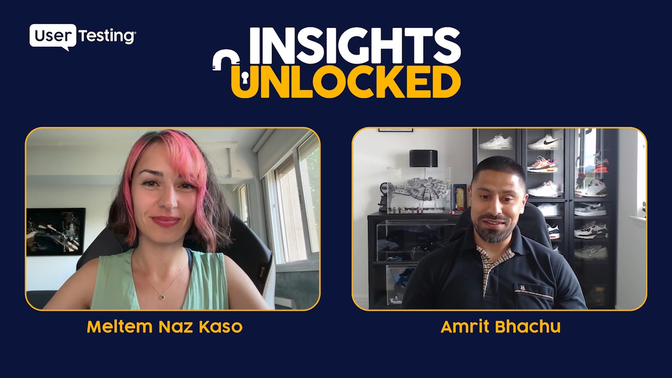
That was the provocative thread running through a recent conversation between UX career coach and former research leader Meltem (Mel) Naz Kaso and UserTesting's Amrit Bhachu. Their discussion explored the future of UX research, the changing nature of influence inside organizations, and the question quietly hanging over many professionals today: what makes someone valuable when technology can perform more and more of the work that once defined a role?
For years, UX researchers have invested heavily in mastering methods. Interviews, surveys, usability testing, journey mapping, quantitative analysis, and synthesis have formed the backbone of the profession. Expertise was often measured by methodological rigor and depth of research knowledge.
But as AI tools become increasingly capable of accelerating research tasks, a different distinction is emerging.
"The answer is not the methodology," Mel said. "Long gone are the days where you can be like, 'Hey, I'm a mixed-method researcher. I can do qual and quant.'"
That doesn't mean expertise no longer matters. It means expertise alone is becoming insufficient.
The future of UX research may depend less on what researchers know and more on how they create trust, drive action, and connect customer insights to business outcomes.
ON-DEMAND WEBINAR
Designing the Insight System of Tomorrow: How UXR Leaders Can Shape the Role of Research in the Age of AI
The profession was never really about research
Mel's career path offers an interesting perspective on the evolution of UX research careers.
Before entering UX, she worked as an investigative journalist. Before journalism, she was an academic researcher studying human development. Across every chapter, a common thread remained.
"It was always about really understanding human behavior," she explained.
That observation cuts to the heart of a misconception about UX research. While the profession is often defined by methods, its real purpose has always been understanding people deeply enough to help organizations make better decisions.
The methods are tools. The outcome is understanding.
Early in her UX career, Mel became fascinated by seemingly small problems that created outsized consequences. A user reaches the final stage of a food delivery purchase. They've chosen a restaurant. They've selected their meal. Their payment information is already saved. Yet somehow they abandon the transaction.
Why?
The answer might be hidden inside a single line of copy, an error message, or a moment of uncertainty.
Those details may seem insignificant. Yet they can influence whether customers complete a purchase, whether revenue materializes, and whether a business succeeds.
"Everything sort of matters," Mel noted.
That mindset remains central to customer insights work today. Yet understanding customers is only half the challenge.
The other half is ensuring those insights influence decisions.
Why trust has become the ultimate competitive advantage
Throughout the conversation, one concept surfaced repeatedly: trust.
As organizations adopt new AI tools and workflows, many professionals are focusing on technical capabilities. Which platforms should they learn? Which certifications should they pursue? Which skills will remain valuable?
Mel believes many people are asking the wrong question.
"The thing that really matters is the ability to build and hold trust," she said.
Trust operates at multiple levels. Customers must trust the products they use. Teams must trust one another. Leaders must trust the judgment of those making recommendations.
Unlike technical skills, trust doesn't have a short shelf life.
A new tool may dominate headlines for six months before being replaced by a newer alternative. Trust compounds over years.
Mel described trust as an asset that professionals can build, maintain, and diversify throughout their careers. It becomes especially important when decisions involve uncertainty, which is to say, almost all meaningful decisions.
"No tool is going to give the final answer," she said. "People will need to leverage their judgments to make decisions."
For UX researchers, that observation has significant implications.
Research findings alone rarely change organizations. People change organizations. Research creates influence only when stakeholders trust the people presenting it.
PLAYBOOK
UX Research Leadership Playbook: Scaling Insight in the Age of AI
The shift from advocate to translator
UX research has long positioned itself as the voice of the customer.
That role remains important. But according to both Mel and Amrit, advocacy alone no longer guarantees influence.
Researchers often find themselves frustrated when compelling customer insights fail to generate action. The data is sound. The findings are clear. The recommendations seem obvious.
Yet little changes.
Part of the problem, Mel argued, is that researchers sometimes become so focused on customer needs that they fail to understand the motivations of the people making decisions.
"If you cannot do that business-driven translation," she explained, "people are going to be like, 'Oh great, there is this user advocate.'"
Translation has become one of the most important skills in modern UX leadership.
Researchers must understand customers, but they must also understand product strategy, organizational priorities, revenue goals, and operational constraints. They need to connect customer experience improvements to outcomes executives care about.
Amrit emphasized a similar point.
"If we want that seat at the strategic table, we need to be able to speak their language," he said.
Think of it like being an interpreter at a complex negotiation. Understanding one side perfectly isn't enough. The value comes from helping both sides understand each other.
The future of UX research increasingly belongs to professionals who can bridge those worlds.
Entrepreneurial thinking is becoming a career superpower
One of the strongest themes from the conversation was the growing importance of initiative.
Mel shared the story of a high-performing client who had become indispensable within her organization. The reason wasn't superior research methods or a prestigious title.
It was proactive ownership.
The researcher noticed information gaps between teams. Different departments were working hard but operating in silos. Rather than waiting for permission, she created a strategic document that connected the dots across initiatives.
Nobody requested it.
Nobody assigned it.
She simply recognized a problem and solved it.
"The entire organization cannot get their hands off of it," Mel recalled.
This type of entrepreneurial mindset is becoming increasingly valuable across product organizations.
Traditional career advice often encourages professionals to focus on execution. Complete assignments. Deliver quality work. Meet expectations.
But thriving professionals are increasingly doing something different. They identify opportunities before they're assigned. They solve problems before they're formally recognized.
"The future of work is entrepreneurialism," Mel said.
For UX research careers, that means moving beyond a service mentality. Researchers who wait for Jira tickets and research requests may find themselves limited. Researchers who proactively identify opportunities for impact create entirely different trajectories.
ON-DEMAND WEBINAR
How Information Workers Leverage AI + Human Understanding to Drive Smarter Decisions
Influence is more human than we like to admit
Many discussions about influence focus on frameworks, stakeholder maps, and communication strategies.
While those tools matter, Mel highlighted a less comfortable reality.
Organizations are fundamentally human systems.
Competence matters. Experience matters. Expertise matters.
But people are also influenced by relationships, perceptions, trust, credibility, and connection.
"You can have all the competence in the world," Mel observed, "if people don't identify with you, if that trust and relationship-building part is not working out, there is going to be frustration."
This perspective challenges a common assumption among researchers: that great work should speak for itself.
The reality is more complicated.
Great work creates potential influence. Relationships convert that potential into action.
That doesn't mean becoming political in a negative sense. It means recognizing that organizations are collections of human beings with competing goals, incentives, and priorities.
The best researchers understand both the evidence and the people who must act on it.
What early-career researchers should focus on
Concerns about AI and automation often hit early-career professionals hardest.
If tools become increasingly capable, where will newcomers gain experience?
Mel's advice was surprisingly optimistic.
Rather than obsessing over expertise alone, she encouraged younger professionals to focus on curiosity, trust-building, and developing unique perspectives.
"It's not about your methodological rigor, expertise only," she said.
She encouraged aspiring researchers to immerse themselves in specific problems, industries, and communities. Build relationships. Ask better questions. Develop original ways of thinking.
Technical skills can often be learned.
Perspective is harder to replicate.
This insight aligns with broader shifts across knowledge work. The professionals who create the most value are often those who connect ideas, identify patterns, and synthesize information across domains.
Those capabilities remain deeply human.
Looking inward before looking outward
Toward the end of the conversation, Amrit asked what small action professionals could take this week to build a more resilient career.
Mel's answer stood apart from typical career advice.
Rather than recommending another certification, networking event, or skill-building exercise, she encouraged reflection.
"I would ask them to look within," she said.
Most professionals spend years focused externally. Projects. Deliverables. Deadlines. Performance reviews.
Few stop to identify patterns in their own work.
What impact have they consistently created?
What values drive their decisions?
What strengths appear repeatedly across different roles and situations?
Mel described careers as the most important product people will ever build.
Like any successful product, a career requires understanding its unique value proposition.
Professionals who can articulate both what they do and why they do it become more memorable, more credible, and ultimately more influential.
That combination of impact and purpose creates a narrative that survives changing technologies, shifting job markets, and evolving organizational structures.
And perhaps that is the deeper lesson about the future of UX research.
The profession may change. The tools certainly will.
But the ability to understand people, earn trust, create clarity, and drive meaningful action remains remarkably durable.
As Mel put it, "The greatest asset, I believe, is trust."
Episode links
- Meltem Naz Kaso on LinkedIn
- Amrit Bhachu on LinkedIn
- Nathan Isaacs on LinkedIn
- Career with Mel website
- Move faster from question to insight and scale confident decisions – Demonstrates how AI-powered summaries and analysis help research teams spend less time synthesizing data and more time driving business decisions, aligning closely with Mel's discussion about using technology to amplify impact rather than replace human judgment.
- From doing research to leading it: how UX research creates real business impact – This podcast episode serves as an excellent guide to one of Mel's core themes: moving beyond research execution to strategic influence, business impact, and leadership within organizations.
- The truth about UX research for AI (it's not just about usability) with Priyanka Kuvalekar – Explores how UX research evolves alongside AI and why trust, human understanding, and judgment remain essential. This closely mirrors Mel's perspective that trust is becoming one of the most valuable assets researchers can build.
- How generative AI is reshaping UX research: Lessons from Google's Alita Kendrick – Examines how AI is transforming research workflows while elevating the importance of storytelling, insight democratization, and strategic thinking. These themes align strongly with Mel's emphasis on business translation, influence, and entrepreneurial thinking.
GUIDE